• home.
  • blog.
  • storytrain manifesto.
  • stories.
    • songs.
    • /answers.
    • poems.
  • publications.
    • articles & books.
    • videos.
    • interviews & reports.

storycodeX

~ The art of story in life, business and business life.

storycodeX

Tag Archives: true story

9TEEN16TEEN: A song that could have been sung 78 years ago …

17 Monday Mar 2014

Posted by Herr Dennehy in hiSTORY

≈ Leave a comment

Tags

1916, authentic, drama, Easter Rising, Eire, freedom, history, independence, Ireland, musical storytelling, oppression, rebellion, revolution, song, story, true story

It’s March 23, Easter Sunday, in the year of 1916. A smoky pub in the centre of Dublin city, bursting with Irish volunteers and crown haters, the scent of men’s sweat and stout medicine; tense anticipation is in the air. Schoolmaster and legend-to-be Patrick Pearse is cutting his way through the underground crowd, accompanied by Gaelic murmur.

Pearse’s freshly thwarted demonstration of Irish resistance to British oppression for this very day is still eating away at him, but he will not let his supporters see or feel his disappointment. He is determined to make a stand against the British and their century-long occupation of Ireland, Plan B must kick in, and now’s the crucial moment, it’s giving up or “now more than ever”.

He climbs the pub’s small stage, pint and hope in hand, to address the crowd.

And this is the song he never sung. But he could have, in this very moment, and maybe he or someone else did, who knows. The song about the Easter Rising of 1916 that was never recorded, lost in the fire fight of history, never recited, forgotten until today. The song that helped mobilise the demoralised debris. The song that summed up centuries of suffering into five minutes, that brought the pub’s atmosphere to the boil. The story song that was the final spark needed to light the historical Easter bonfire, flames enough to engrave freedom as something indeed achievable into the Irish soul. A fire that lasted for only six days, but whose smoke signals reached out years into the future, forming silhouettes of an independent Ireland, the Eire that was officially constituted in 1937.

These are the improbable song’s lyrics. It could have been called “9TEEN6TEEN”:

…………….

“It’s been a thousand years and it’s so hard to tell,

More than a million tears though I should know it well.

Will anybody tell me when it did start?

Well, in fact it don’t mind as it’s been god-damn hard.

They came across the sea with a plan in their head,

And at its open end we would surely be dead.

Tried to take away our pride and annex our land,

But they never realised how we’d make our stand.

And now we’ll rise, we’re gonna rise at Easter!

We’re gonna rise, and we will make the whole world see!

We’re gonna rise, we’re gonna rise at Easter,

Cause we’re sick of all the tyranny and greed!

They took all we had, much more than we could bear,

It won’t happen again, this to you all I swear.

No more rapin’ our wives, mutilatin’ our kids

By now the only tongue they speak is the row of our fists!

So many battles won, so many children lost,

Can’t you feel a shudder in your heart rehearsing this cost.

So don’t you tell me nothing ‘bout no two in the bush,

Cause it can’t get any worse, come out and make a rush.

Just come and rise, come on and rise with me at Easter!

We’re gonna rise, and we will make the whole world see!

We’re gonna rise, come on and rise with me at Easter,

Cause we’re sick of all the tyranny and greed!

We tried the peaceful way, it only led them astray,

Out to the wilderness that reappears every day.

What was believable once is unbelievable now,

So now I give a fuck for anything they say.

We’ll chop the bloody hands that tried to kill our will,

And use them in return to show we’re living still.

So come on and chant will me the song that we all know

Cause by the time the sun will rise it will be time to go!

Time to rise, we’re gonna rise at Easter!

We’re gonna rise, rise and make the whole world see!

Come out and rise, we’re gonna rise at Easter,

Cause we’re sick of all the tyranny,

Sick of all the tyranny,

Sick of all the tyranny and greed!”

………………..

HAPPY ST. PATRICK’S DAY!

And: Cheers down the Hatch!

Source: http://www.whitelightsonwednesday.com/2012/03/guinness-gingerbread/

Source: http://www.whitelightsonwednesday.com/2012/03/guinness-gingerbread/

Share this:

  • Click to share on X (Opens in new window) X
  • Click to email a link to a friend (Opens in new window) Email
  • Click to share on LinkedIn (Opens in new window) LinkedIn
  • Click to print (Opens in new window) Print
  • Click to share on Telegram (Opens in new window) Telegram
Like Loading...

The Power of Story on a Sunday Morning … with Löwenzahn.

10 Monday Mar 2014

Posted by Herr Dennehy in experiences, Stories worth watching

≈ 1 Comment

Tags

business storytelling, change, drama, education, entertainment, expectation, Fritz Fuchs, hero, Human, Löwenzahn, lep's world, little big planet, narration, Peter Lustig, plot, script, subway surfer, surprise, true story, writing, Yasemin Saidi

It was one of those Sunday mornings I love: The kids let you sleep in (relatively) long, the weather is Irish, and prevents your bad conscience from creeping in when you decide not to leave the house all day.

I trot to the breakfast table and put the espresso macchinetta onto the stove, waiting for the promising scent to fill the flat, inviting the rest of the clan to leave their caves. Table is laid, time is not an issue, I just love it.

This particular Sunday was a special one, also in another way. For my daughters, as they were able to take advantage of their parents’ laid-back, rainy Sunday mood, and watch a little TV in the kitchen. And special for me, as I more than happily interrupted the breakfast cleaning-up routine to watch a brilliant piece of self-reflexive, story-in-story narration with them, made for kids, but very fulfilling for me as well. It was an episode of one of Germany’s most renowned, most famous, and best children’s programs called “Löwenzahn” (English: Dandelion).

loewenzahnSe Dschörmens amongst my readers will know this program that started way back in 1981 very well, along with its quirky former hero Peter Lustig (English: Peter Funny) who lives in an old, cozy construction trailer in the fictitious city “Bärstadt” (English: Bear City) – and has numerous entertaining and educative adventures to master.

The series still exists, since 2006 with a new hero called Fritz Fuchs (English: Fred Fox), and every one of the so-far more than 300 episodes is worth a kid’s and a grown-up’s while, probably worth a blog post for every single one. But episode 298, which I am referring to here, is called “Geheimnissvolle Botschaften” (English: Mysterious Messages). What could also serve as a nice title for many a corporation’s annual report, is in this case true storytelling at its best, storytelling about storytelling, storytelling about telling stories, storytelling about scripts, writing and the art of language, and the value of narrative traditions. Yep, education on a Sunday morning!

…

…

It’s about kiosk owner Yasemin Saidi and her quest to unveil the mystery of an ancient-looking parcel she receives. A parcel from a far-away country, with an already faded, oriental handwriting, from no one less than her Persian grandfather who has recently passed away. The parcel contains a riddle for her to solve: Should she be able to decipher three characters from three different writing ages, there will be a treasure waiting for her, writes her granddad. She begins her treasure hunt aided by a pawky boy from next door. A hunt that leads them back to the history of storytelling, oral lore, campfire fairy tales cave paintings to the beginning of writing and further on and on through time and historical imagination.

At one point, she tries to memorize a story she loved her grandfather tell her when they were still together in Persia, but she simply can’t remember the end – much to the boy’s dismay, who is hanging to her every word. In expectation, hoping for a surprise ending, for the heroine’s fate to change for the better, but: Yasemin simply can’t remember. Until, in the end, when the two of them manage to solve the riddle and decipher the characters, they find her grandfather’s treasure … and she does remember, or better, is helped to remember: The hidden treasure is all stories her grandfather ever told her, put to paper by himself and collected in an old suitcase, preserved for her to tell and carry on – and never to forget.

…

Our Sunday morning (or was it still morning?) had come to an end, the kids were happy and entertained, their father entertained and happy. Happy that the art of storytelling, the power of language, and the value of writing are still a valued piece of children’s entertainment in the age of Subway Surfer, Lep’s World and Little Big Planet.

Thanks, Löwenzahn! 🙂

Share this:

  • Click to share on X (Opens in new window) X
  • Click to email a link to a friend (Opens in new window) Email
  • Click to share on LinkedIn (Opens in new window) LinkedIn
  • Click to print (Opens in new window) Print
  • Click to share on Telegram (Opens in new window) Telegram
Like Loading...

Stories worth watching #4: The Voyage of Sumeet and Chetna

26 Wednesday Feb 2014

Posted by Herr Dennehy in Stories worth watching

≈ 6 Comments

Tags

authentic, Authenticity, brand storytelling, British Airways, business storytelling, change, corporate storytelling, digital storytelling, documentary, drama, expectation, Hollywood, personal stories, plot, Sumeet and Chetna, surprise, true story, Truth, video storytelling

This story literally came flying into my inbox the other day, the subject merely indicating: “British Airways is also doing personal stories now”. The sender surely seemed to know how to catch my attention … and there was no comment as to whether BA’s attempt was successful, in the sense of good-story-successful, not youtube-clicks-successful. She left that to me to find out …

Overcoming an instinctive cerebral reflex of rejection by the notion that this is probably just another ad in sheep’s (or cheap) clothing – and henceforth the source of evil that continues to insult my intelligence by insinuating authenticity while actually shouting out “CLICK HERE AND BUY ME, STUPID!” –, I followed the link anyway. And I was rewarded; in one way, not in every.

…

…

OK, there’s a decent slice from the cheesy cake mixed into this film, but: a really good story it is. And if it’s a well-told story, I do admit to being susceptible to some nice, unpatronizing cheesiness every now and again, that lets me escape from our technocratic, data- and perfomance-driven world … hmmm, maybe I’ll start a list of the best-told and produced stories that made me cry and were not good despite, but because?.

I was glad that nobody was watching when my eyes premiered this film in the office … 😉

…

What’s so good about this story?

  1. That it makes me experience the “like me” effect. Even though it’s plotted in a world completely foreign to my own. Even though the heroes’ sufferings are (on the outside) something I will (probably and hopefully) never be exposed to myself, but (on the inside) something that’s as close to my heart as Romeo and Juliet, Florentino Ariza and Fermina Daza, or László de Almásy and Katherine Clifton.
  2. That it manages to take the seemingly very specific story of an organized, yet later love-match-to-be marriage and its challenges in modern Indian life to the broader sphere of She and He. Of Love and Sacrifice. Of Desire and Deprivation. Of Longing and Letting Go. And so on. Universal themes of togetherness and separation and all the shades of grey in-between. It doesn’t matter, whether our two heroes are Indian, American, German, Chinese or African: These kinds of experiences are all the same, all over the world. We know them, and we feel them when we see them – and feel even more when we experience them as true (and I haven’t found any lead anywhere yet that this story is scripted or fake).
  3. That it clearly follows the storycodeX of Expectation, Surprise and Change in a way that is not totally surprising, granted, but despite its predictability it is convincing and true to its own inner truth. Even though I had a pretty good feeling for how the story will end, I still didn’t want to miss the satisfaction of the closure living up to my expectations. And it did.

Still … Why is this story and especially the overall British Airways campaign behind that story so very far from perfect?

  1. First of all: the music. It begins OK, adequately subtle as the story unfolds, and the hero introduces himself. But after a minute already, the unwelcome feeling creeps over me that a soundscape is about to invade my ear conch, and oh how I hate that. At minute 2:45 it almost becomes unbearable, this crescendo of paternalism, acoustically giving me the order what to feel in a couple of seconds. Again, how I hate that. Although I also hate it when it works, when my heart answers through my lacrimal glands while my brain is saying “No! Don’t! They’re just manipulating you!”.
  2. The documentary start of the film (if you ignore the fast-motion sequences, which you definitely should, they’re so eighties and boring!) maybe does not have the intention of fooling me, but it does. Because in the end it turns out to be an attempt to imitate Hollywood. Especially after minute 3:30, this becomes all too evident: slow motion, seemingly staged or at least retook scenes, too much forced effort on an image-text match. At the end and with Sumeet’s fit-to-campaign-and-landing-page-title slogan “Sometimes we have to go really far to get close”, this becomes even blunter – and leaves a bad taste in my mouth. I hate being fooled.
  3. Speaking about the campaign (the above arguments are a little prone to taste, but the following is a fact): It’s a laudable one, with a nice and true core message, showing the authentic benefits of a brand and its actions for its recipients (or more abstractly: target audience). This campaign goal surely is reached (emotionally, that is, I have no knowledge of the quantitative results apart from 1.8m YouTube views to date). But, in the end, it turns out to be just another poor attempt of deviation, pretending to want one thing (in this case: make people happy and tell a good story), when in the end it’s ever so obviously about another thing (in this case: make people book flights with BA, and not just somewhere down the Brand and Sales Funnel, that would be OK, and expected, and accepted, but RIGHT NOW, STUPID! No subtleness, no intelligent weaving of one story into a greater theme or idea.). When I enter ba.com/getcloser, I don’t (as I would have hoped for) get more content of the kind I have just seen, that is other example stories of BA’s impact on human happiness, not even a “more to come” message in case this is the first episode of a planned series. Nope, nuthin. Instead, a simple, plain, in my eyes insultingly profane flight booking page as you actually would expect at BA.com, not on its apparently os so human “get closer” campaign landing page. And then I even find out, how our happy heroes are exploited for a whole bunch of other online marketing measures such as Facebook quiz asking me (as a story seeker!) how close I am to whomever. I can even win a flight to get even closer. Can it get more right in the face? Phew. And URGH.

A shame. An insult, And a wasted chance of a sustainably credible campaign that started off so promising – with a good story.

Share this:

  • Click to share on X (Opens in new window) X
  • Click to email a link to a friend (Opens in new window) Email
  • Click to share on LinkedIn (Opens in new window) LinkedIn
  • Click to print (Opens in new window) Print
  • Click to share on Telegram (Opens in new window) Telegram
Like Loading...

This is NOT a story #1: The Dylan Chrysler Experience

10 Monday Feb 2014

Posted by Herr Dennehy in This is NOT a story

≈ Leave a comment

Tags

Aristotle, Bob Dylan, brand journalism, brand storytelling, business storytelling, change, Chrysler, Clint Eastwood, conversations, corporate storytelling, David Bowie, digital storytelling, Dirty Harry, drama, expectation, hero, Louis Vuitton, plot, surprise. suspense, tension, true story, video storytelling

Sometimes, a man’s gotta do what a man’s gotta do. And sometimes, the world actually takes notice. Sometimes even a little too much. As in the case of Mister Robert Zimmermanns’ latest coup in a lifetime effort to alienate his lovers, re-assure his haters, and simply do everything possible to not fit into one of those boxes that our world so loves to create to get a grasp at the ungraspable: Life.

I’m talking about the new piece of advertising Dylan has allowed US car manufacturer Chrysler to produce using him as a mighty testimonial:

…

I’m neither going to chime into the (ridiculous and so 1965-Newport-Folk-Festival-like) fundamentalist fan mob’s “OMG! He’s selling out to commerce” outcries, nor will I (at least not yet, that is…) offer any half-baked analysis of why Bob is such a genius, why he’s never there, always the passenger of a slow train coming with no direction home, always already part of a new morning, heading for modern times, leaving blood on the tracks while his worshippers are still marching on desolation row towards the Gates of Folk Eden. No, others have done that before, probably better than I ever could.

Which is why it does indeed surprise me that he still actually manages to surprise, at least some, with his ambiguous “it ain’t me, babe” smile on his face. If it were up to me, he could advertise Pepsi refreshments or Victoria’s Secret ladies garments, I’d still not stop to admire the Zimmermann Phantom and his many ways of deliberate and couldn’t-care-less fanielation. Oh, he already did??? Ahh, whatever. 😉 Those two were at least entertaining, somewhat intelligently composed, and equipped with some more Dylan-esque “in-between-the-line-ness”.

No, what this here is about is my bewilderment by the fact that the Chrysler spot simply is a poor piece of pathetic advertising – and story-wise plainly sucks, because it isn’t a story, but pretends to be. And that a man, who has created himself a well-earned reputation as a musical storytellers of and about his time, agreed to be its centerpiece (I won’t call him hero in this respect, as it’s neither heroic what he’s doing or saying, nor in any way dramatic in the Aristotelian sense to make him deserve this title).

Why Chrysler is doing this, and exactly in this fashion, is clear: It’s an American company, more up-to-date American never than here, appearing desperate and back-to-the-wall-ish, seeing hopes dashing in many an economic sector; automotive, for example. They draw the marketing card of desperation (by the way: already Act II of the company’s Drame du Deséspoir after Act I where they threw Dirty Harry into the ring two years ago): Take a well-known, respected, but still a little controversial celebrity (you know they’ll love or hate him for this!), use clichemotional imagery of what makes America’s nerves shake (no way to err with cheerleaders and cowboys on horses in slow-mo, a little stars and stripes and historical analogies, babies and hard-working factory laborers!), polarize and tease your rivals a little (not too much, just a little to add spice to the saltless soup and give the regulars’ table something to talk about), and end with the all-too-expected “Wir sind wieder wer!” message stolen from se Germans in 1954. Oh, and not to forget: Pay millions to place this ad in front of the world’s eyes at the Super Bowl finale – where reach really still means conversion and conversation. About what, that’s another question.

Why Bob Dylan is doing this, Alias knows. Maybe to escape from the burden of being witty, erudite, convoluted, and the role model of more than one generation all the time, into the shallowness and immediacy of corporate advertising every now and again? Maybe just for the fun of acting while actually being an actor and not a singer-songwriter? Maybe for the dosh? Maybe, maybe, maybe … who cares? I don’t.

But what I do care about being insulted by bad ads and videos and films that pretend to be stories. Why do I think this one is so bad, may have become obvious above, below and in between these lines so far, but a friend of mine recommended I add a kind of management summary at the end of my posts to avoid the feeling of “Wow, that was interesting, but, err, what was it about again?”. So here it is, my dear Performance Passionist: 😉

  1. Nothing’s happening. Nothing’s changing. It’s simply boring. I wouldn’t want to watch it to the end without all the media fuzz about and Bob Dylan in it. I would leave the latest after 30 seconds.
  2. No surprise. No one manages to surprise me here, and seems like no one even wants to. The surprise of seeing Bob Dylan make-up-ed and hair-dyed after 18 seconds is the only surprise you get – and I’m left with the fear that the analogy of Dylan not holing any ball at the end might have a deeper meaning. A message triangle gone video.
  3. No hero, no plot. There is no hero, only a narrator narrating through a non-existent plot. But actually narrator Dylan ain’t telling, he’s just talking, saying things that only scratch the surface of America’s story and the story of every American shown in these two minutes. Shallow and predictable. And don’t mistake the narrator for the hero, neither the story-immanent one nor the one you think you’re seeing. It’s only Bob (whoever that is) playing someone else.
  4. No expectation. Neither within nor without this advertisement am I expecting anything, let alone more – and arousing no expectation is the worst mistake being made here. The fact that nothing is happening could, however, be countered by the tension and expectation of what might happen AFTER the short scene just shown. As it was actually quite successfully attempted in Dylan’s Victoria’s Secret spot in 2009, or in last year’s Louis Vuitton spot with David Bowie. Both not stories per se, but the beginning act of a potential plot continuation, a story teaser, making me expect more to come, wanting to know, if and how this scene continues. Not so with The Chrysler Boredom.

The only chance this spot has for a longer-term success and more sustainable, content-based conversations (beyond the “Have you seen the latest Super Bowl ad with Dylan?” reflex) about the big theme the ad is suggesting (“The people of America and their love to manufacture something with their own hands that provides a living for their families and a sense of pride to be giving the world something it wants, needs, and maybe even copies”), is a prolongation of this mere advertising pretension into the digital space.

A prolongation that includes every little story of every single potential hero in this two-minute film. The young lady wrapped in the Stars and Stripes at second 0:08. The grateful-looking old man at second 0:14. The waitress serving him. The mother with her(?) child at second 0:54. The factory worker at minute 1:04. Or any of the men standing behind the pool table like tin soldiers at the end. These stories, if indeed they exist, would prove that the above big-story suggestion is not just advertising bullshit, that the company able to pay so much money for production and airing of this ad actually is capable of lighting the spark of pride in these peoples’ hearts. That it maybe even manages to help improve their lives. Most importantly, this would prove that they’re not all just casted models for a seemingly authentic TV spot.

… And then there would be the story of this old man with the dyed hair who wants us to believe that he is who he seems to be, that he is actually someone we know, someone like you and me, and not just some Alias playing a role in innocent Billy the Kid’s endless fight against the unjust hands of some imported Pat Garret imitation …

That would be a story. A completely different one. One that many have tried to tell, but no one really knows.

Share this:

  • Click to share on X (Opens in new window) X
  • Click to email a link to a friend (Opens in new window) Email
  • Click to share on LinkedIn (Opens in new window) LinkedIn
  • Click to print (Opens in new window) Print
  • Click to share on Telegram (Opens in new window) Telegram
Like Loading...

Story is Life, and Life is Memory. Memory of Stories.

27 Monday Jan 2014

Posted by Herr Dennehy in experiences

≈ 2 Comments

Tags

admonish, Alexander Liebmann, commemorate, Concentation Camp, Deportation, First World War, Gang der Erinnerung, history, Hitler, Jakobsplatz, Jewish, learn, live, Maike Tellkamp, mourn, Munich, Nazi, Ohel Jakob, Path of Memory, reconcile, remember, Second World War, speak, story, synagogue, true story

Today, I followed my wife’s recommendation to attend a very special event: A guided tour through Munich’s still considerably young new main synagogue “Ohel Jakob”. The weather was miserable, the girls nevertheless out for an extended walk with a good friend’s dog (and the friend, of course) along the river Isar. So I took a trip down memory lane, the memory of uncountable and unaccounted for tragic stories of Munich victims of the ruthless Nazi Regime.

I’m very glad I went. Not only is everything that has to do with the past, present and future of our Jewish communities in Germany a must topic of interest for anyone only remotely interested in history and equipped with an ounce of collective conscience. The new main synagogue in Munich is also a miraculous site to see and explore. It’s a place of light, a place of hope, a place that literally and perceptibly seeks reconciliation and a bright future, in the middle of the city, in the midst of its people.

It’s a place where light and shade are one, where you can feel the true meaning of hiSTORY.

The first indication of which is high-tech: security detectors. You can’t enter into the fane without a security check, without prior registration with an official guided tour, and not through the actual, beautiful synagogue entrance. Deranged anti-Semitic ideology debris is still a threat; it never seems to be really over. In fact, even in 2003, the year of the laying of the synagogue’s cornerstone, German authorities uncovered a plot by a group of neo-Nazis who wanted to bomb the ceremony.

I am allowed to enter, fortunately, along with about 40 other interested people. We wait in the very modern entry hall of the Jewish community center for a good friend of mine, Maike Telkamp, who was about to take us on a vibrant, informative and emotional tour through past, present and future of Munich’s Jewish community.

Today’s stories are being written as we live, right here, right now. Tomorrow’s stories are yet to come. It’s yesterday’s (hi)stories that not only make the today we have possible, maybe the only today alternative there could be; they pave the way for the crossroads and stories of the future. Maike made this very obvious and tangible in her almost 90-minute tour. And the most impressive part of this experience was not her profound knowledge of the subject (that was probably to be expected, this being her job and all, nevertheless impressive and illustrative). It wasn’t the bullet points of her speech, the fact, the figures, the features of the buildings, the art within, the technical details.

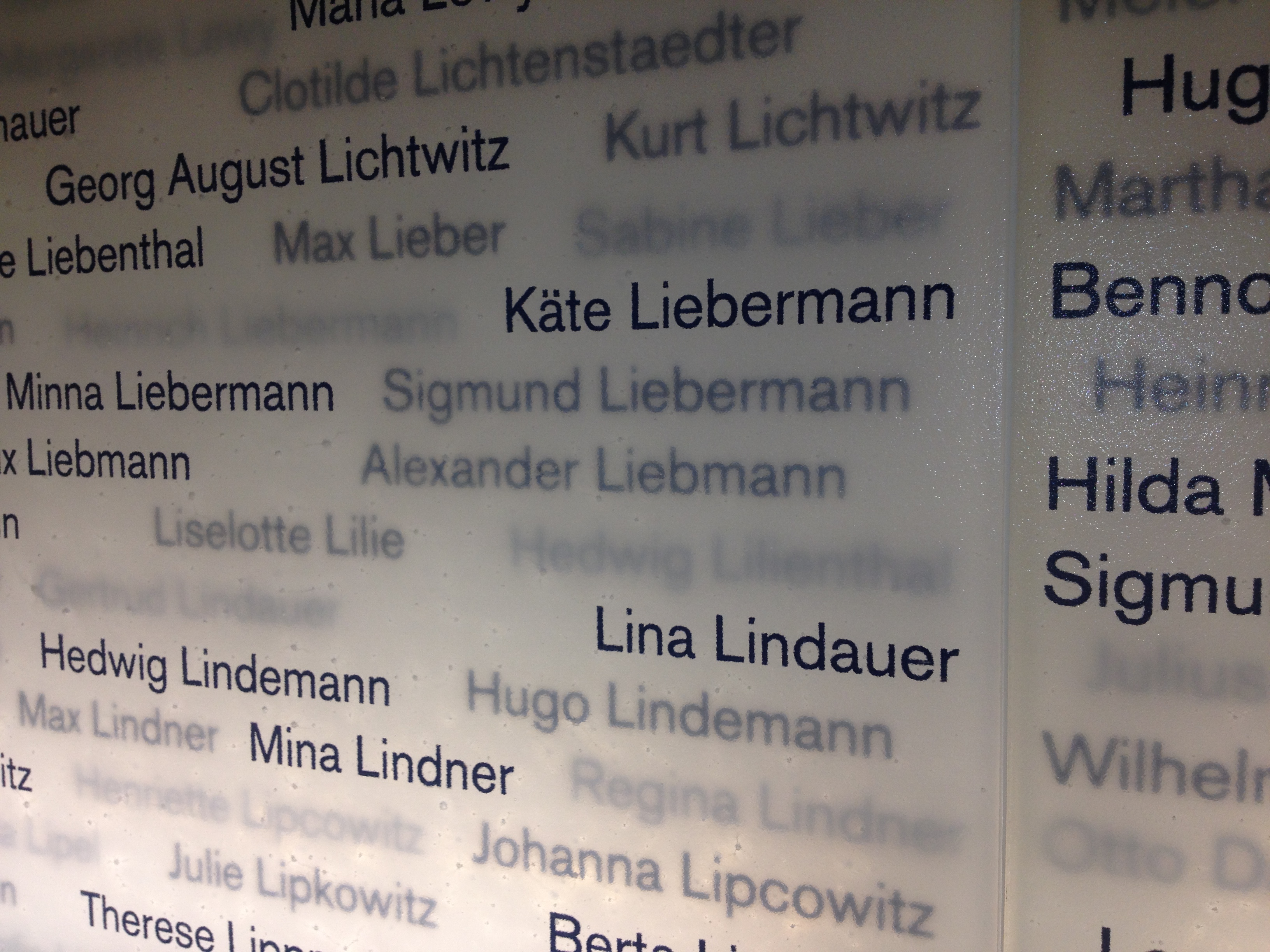
At least to me, it all came to life and (even though you think you know it all, you’ve seen it Picture by Tobias Dennehyall, you’ve read it all) hit me in the epigastrium like the punch of a heavy-weight boxer, bringing tears to my eyes, when she told this one man’s story: Alexander Liebmann. His name is one of the 4.500 names displayed by a very intelligently, very impressively, yet subtly constructed piece of art, the center of the so-called “Gang der Erinnerung” (The Path of Memory) that leads believers and visitors from the community center to the synagogue. A quiet, reflective room, it every meaning of the word. Over a length of 32 meters, 32 glass panels, illuminated indirectly from behind, show the names of every single man, woman or child accounted for as a victim of the Third Reich. In varying boldness and legibility, symbolizing the degree of oblivion that has laid its cloak onto these human’s destinies ever since.

The sheer mass of names alone renders you taciturn, only put into perspective by the figure “6.000.000” engraved into the opposite wall of this Memory Path, above a massive Star of David. Picture by Tobias DennehyAs impressive and shattering as these 4.500 names are, they are abstract, just names. You might walk past, awe-struck, with a bad historical conscience, but you would not be emotionally taken aback. It’s Alexander Liebmann who does exactly that, or better his story that Maike tells while explaining make and meaning of the Memory Path. Like the zoom of a camera onto an individual in the middle of a large crowd:

Liebmann was born on October 31, 1871, in Berlin, where he studied at the Berlin University of the Arts, even travelling to Paris every now and then for research. After working as a teacher, he fought for Germany in the First World War, rPicture by Tobias Dennehyeturning severely wounded and a war hero. His injury made it impossible for him to do most jobs that could have helped him make a living, but he and his wife were gladly employed by a friend as porcelain painters is his ceramic manufacture. When Alexander and Johanna Liebmann received a note on March 27, 1942, to be ready for deportation to a concentration camp on April 3 (simply for being Jews and after receiving the “Eiserne Kreuz 1. Klasse” and the “Hessische Tapferkeitsmedaille” for heroic services in the name of the same country that was now planning to kill them), the couple decided to leave together at least in the manner they decided themselves, if not the when: they committed suicide.

The rest of the tour was still interesting and informative, but it was always Alexander I saw.

As I was standing in front of the only remains of Munich’s former main synagogue which was burnt down by Hitler’s henchmen in June 1938: I saw Alexander there, praying, celebrating the Shabbat.

As I put on the Kippah to respect the house of prayer, I saw Alexander being harassed in his own city for wearing it, for believing.

As I was sitting in the synagogue’s front row, listening to details of the Jewish divine service rituals, looking up to see the last ray’s of today’s sunlight being refracted by Picture by Tobias Dennehythe ingenious metal construction that embraces the massive roof windows and suggests the form of the Star of David over and over: I saw the hope that had left Alexander and Johanna back in Berlin of 1942 – the hope that this place now radiates, for today and tomorrow.

Not only for the Jewish community, but for all of us, especially for our children, who need to remember, always, never forget, understand – and live to see a day when religion is a reason for joy, love and life, not the cause of fear, hate, and death. When the first four words engraved into the wall of the synagogue’s Path of Memory (“remember – mourn – commemorate – admonish”) truly lead to their four counterparts at the end of the tunnel (“learn – reconcile – speak – live”). A day when one of the questions asked after the presentation part of the tour (ironically by a little boy of maybe ten or twelve years of age) whether “Jews and Germans both come here, or only Jews?”, will not need to be asked anymore.

Picture by Tobias Dennehy

Back home, over dinner with the family, we all reported from our day: Chasing our friend’s dog along the banks of the Isar, returning home happy, hungry and tired – on the one hand. Chasing ghosts of the past along the Path of Memory, returning home tired, hungry, and happy to be alive today, to enjoy the fragility of piece with the ones I love. And being willing and able to remember the stories of the past, helping them create a better narrative for our future.

Next time, I think I’ll take my kids along …

Share this:

  • Click to share on X (Opens in new window) X
  • Click to email a link to a friend (Opens in new window) Email
  • Click to share on LinkedIn (Opens in new window) LinkedIn
  • Click to print (Opens in new window) Print
  • Click to share on Telegram (Opens in new window) Telegram
Like Loading...

Stories worth watching … #2: Jaguar

13 Monday Jan 2014

Posted by Herr Dennehy in Stories worth watching

≈ Leave a comment

Tags

advertising, business storytelling, corporate messages, corporate stor, Damian Lewis, desire, expectation, jaguar, Jordi Mollà, lana del ray, plot, product features and benefits, ridley scott, Shannyn Sossamon, sports car, surprise. suspense, true story

Somewhere in the desert between America and Mexico. An endless black asphalt snake slithering through an intimidating vastness of brown, dry, merciless mountains. On the snake, in the distance, a car on the move. You can see (and somehow feel) the heat, the sun shimmering on the desert street. Suddenly, a man (or woman?) with a black motorbike helmet, steps out of the shadow of a rock prominence, observing the (now revealed: red sports) car. Screeching dirt-bike tires, a blinding smoke of sand, the motorbike drives head-on towards the sports car, at the last minute avoiding a collision. Bike and rider slide along the asphalt, bringing the car to a halt, and its driver to get out of the vehicle and check the seemingly unconscious biker’s wellbeing. BANG! The biker grabs the sports car driver and …

“One man. One job. But in the desert, nothing is simple.”

That’s what the video’s subline says.

It is nowhere, I’d say. But certainly nothing is what it seems in this very intelligent, bold and entertaining piece of corporate advertising about a man driving a very desirable convertible sports vehicle through the desert towards Mexico, meeting a beautiful woman who jumps into his car on the escape from her kind of choleric, overly protective, gun-loving, probably violent drug cartel boss husband. Who in the end catches up with them, and then …

Before we go on, you should enjoy the piece, and don’t let the length discourage you, it’s worth every second:

http://www.youtube.com/watch?v=O-uvmDlG_9s

So what makes this piece of moving image that Jaguar had produce for the launch of its new F-TYPE sports car called “Desire” a true, well-told story? A story you (or at least I) desperately want to follow to the end – despite its epic 13:24 minutes (for me great counter evidence of the alledged commandment of brevity for content on the web)?

And to take the wind out of all those whining marketers’ “we don’t have enough budget” sails: It’s NOT the fact that it’s a Ridley Scott Associates production. It’s NOT the fact that it has Golden Globe winning actor Damian Lewis as well as Shannyn Sossamon and Jordi Mollà performing brilliantly in this film. And it’s NOT the great score including a song by BRIT award winner Lana Del Ray. Granted, it may help to have someone direct your advertising who knows his craft as a storyteller, but being good is not a question of budget.

For me, the following points make “Desire” a good story – or a story at all:

  1. Plain and simple: It has a PLOT. Aka something is happening, something changing for the better or worse. On the broad scale of the overall almost quarter hour drama (“Man to deliver luxury car to wealthy client somewhere in the Mexican boondocks”), as well as in many micro-dramas along the way, e.g.: biker seizing car driver; woman hijacking car and driver; driver realizes the man he is supposed to deliver the car to is the man trying to kill him; the driver’s decision, not to deliver, but to help the escaping women; and so on, and so on.
  2. It plays with the essential ingredients of story in the classical way that every great film, book or speech ever created does: EXPECTATION and SURPRISE. You want to know how the story ends! A story which simply is fun, not only because there’s lots of action scenes (which we men love), and some maternal-drama-meets-forbidden-love elements (which woman love, and men, too, c’mon, be honest, guys!), some nice grains of British humor lightening the tension between the protagonists, very well supported by a great musical score). But mainly because you want to know what happens next, and next, and next, and in the end. So, in a classical action-meets-love-story way, in terms of storytelling: nothing novel, not much innovation. But: In the respect of consequently integrating this into business storytelling and product adverising: indeed innovative. And intelligent.
  3. Speaking of intelligence: I recently wrote, and would stick to this over and over again, that nothing is more boring for the recipient of a piece of business communications than a bleeding list of product features, benefits and what have you. But this film quite impressively shows us that, if you intelligently weave your “corporate messages”, your product’s miraculous features into a story: it can work and even be fun to listen to them. And, most importantly: You believe them! I mean, can it get any better than from minute 09:30 to 10:55? You (or at least I) actually believe Mr. Martinez when he says: “Now that’s a good car!” Within the plot, it does indeed seem credible that this paranoid mad man would detour from the most suspense-packed part of the story, the live-or-die, keep-or-lose-wife climax, by asking for the features of the car he ordered. The story stops for advertising, which you hardly notice at first, and when you notice, you like it, you bow your head and think: “Damn, if I could afford it, I’d go right out there and buy me one!” Or at least I do. 😉

So, what do you think? Agree? Disagree? Why?

In any case: I’m happy to see you again soon, here, where the story goes on … soon.

Share this:

  • Click to share on X (Opens in new window) X
  • Click to email a link to a friend (Opens in new window) Email
  • Click to share on LinkedIn (Opens in new window) LinkedIn
  • Click to print (Opens in new window) Print
  • Click to share on Telegram (Opens in new window) Telegram
Like Loading...

“What IS story? And what ISN’T?” … Part 3: The Truth Aspect

08 Wednesday Jan 2014

Posted by Herr Dennehy in Ideas

≈ Leave a comment

Tags

Aristotle, Authenticity, boardwalk empire, brand storytelling, business storytelling, corporate storytelling, documentary, Gabriel Garcia Marquez, Love in the Time of Cholera, Martin Scorsese, social media, Steve Buscemi, story structure, storyteller, true story, Truth

“Never let truth get in the way of a good story.”
Nucky Thompson

Now that’s a sledge hammer statement, I’d say.

More truth behind it, however, than you find in most of the business “stories” out there, that’s a fact. A truth that’s just as old as story itself. Especially in the context that Steve Buscemi’s character utters it in Episode 1 of Terence Winter’s and Martin Scorsese’s no less fascinating mob series “Boardwalk Empire” – which is politics.

Unfortunately, this has no less been true for the sphere of economics and business ever since we started to trade mammals for firewood way back in the days – or bonds and shares for lies on Wall Street just recently. And as we all know, business is nothing but politics, so in a way you could say that corporate messaging is suffering the same slow death as capitalism is, or at least the locust version that brought down the Lehman Bros: People don’t buy it anymore! They want (cognitive or emotional) proof, either from
– own experience
– a friend’s recommendation (or disapproval), or
– a gut feeling that a corporation is telling a true story.

And the latter gut feeling can, today, always be unmasked as false by a friend’s or so-called “user’s” – what an irrespective word for a person getting in touch with your corporate content, I’ve always hated it … just a gut feeling … 🙂 – disapproval, or also own experience. Recapitulating: Social Media = Storytelling and Social Media unmasks every corporate lie aka bad messaging story attempt, sooner or later!

OK, but: truth is not always the same in good and true storytelling. The way I see it, there are two dimensions of truth in story:

Authentic / documentary / historic / objective / non-fictional truth
This is the kind of obvious truth we all know: What is told in a story (film, book, theater play, you name it) is indeed authentic, i.e. it REALLY TOOK PLACE. The protagonist is A REAL PERSON whom we are either witnessing during a positive or negative, but in any case dramatic (in the literary sense) part of his life that is at that moment REALLY TAKING PLACE – or who is acting as a witness of this drama that REALLY HAS TAKEN PLACE sometime in the past. The classical documentary. There is a truth behind every documentary that we can investigate (if we find time and pleasure to do so), that we can prove or refute. Any well-told and well-researched history book or TV program falls into this category as much as any animal documentary or social reportage.

Inner-fictional logic and subjective truth
If objective truth was the only dimension of truth that made a good story a true story, then all Hollywood films, all great novels of literary history, every poem, every comic, etc. would be “un-true”. Which they are not. They all have an inner logic, an inner truth which they follow to the most meticulous extent – if they are well-built and well-told. Everything COULD HAVE TAKEN PLACE the way it is described, the protagonist COULD HAVE existed and experienced the described drama, even though in another or maybe even a fictional world.

Take Garcia Marquez’ “Love in the Time of Cholera” – one of the greatest love stories of the 20th century – as an example: Young Florentino Ariza and lovely Fermina Daza COULD HAVE really fallen in love with each other, secretly living this forbidden love through an orgasm of passionate love letters despite the forced separation by Fermina’s father. Florentino’s love COULD HAVE kept growing ever fonder and deeper and undying despite Fermina’s marrying handsome Dr. Juvenal Urbino, at first under arranged circumstances, then with real affection and love, which led her to exclude her former lover Florentino from her life. And after almost a century of undying, in fact evermore flourishing love to this evermore unreachable lover, Florentino COULD HAVE waited all those years for his true love, and the two of them COULD HAVE met decades later after Urbino’s tragic death to renew their old love just before the end of their lives, on an old Mississippi steamboat …

51e2eOuVQBL._SY344_BO1,204,203,200_

Gee, I’m getting carried away … you SHOULD read this book, true recommendation! Simply reliving the memory of reading this novel gives me goose pimples, although the plot is of course fiction, it did NOT really take place, but it is so well told that I am convinced it COULD HAVE – and maybe has?

What I mean by all of this and what Florentino’s ordeal d’amour has to do with business story: In general, a real and good story can have either an objective, provable plot, or a truth made true by the inner logic of a fictional narrative. Both need not only the classical elements of story structure (a future post on this blog will elaborate a little more on this aspect, rest assured!), but also a capable narrator.

OK, and this is where most business stories fail, miserably:
– First of all: They have no story structure
– Then: They very seldom make use of capable and experienced narrators and storytellers; they rather use brain-washed, submissive agencies or brain-washed, inexperienced employees
– They – what is worst in the context of truth – mix truth (real people like employees or customers and real products) with fiction (corporate messaging bullet point as pre-scripted storyline and treatment structure elements that claim to be authentic) without transparently distinguishing the blurring barriers for the viewer or (abused) user.

So, to come to an end here:

If you’re a business storyteller, stick to the truth and nothing but the authentic, documentary, objective and provable truth.

If you’re a screenwriter or novelist or poet or painter or whatever artistic inventor of truths, make sure you adhere to the inner-logic of this fictional truth. But you can also – and that’s kind of unfair – not only invent truths, but also combine invented truths with real, authentic, objective and historically provable truths and still tell a great and credible story. Grrr, damn these artists!

But then again: Life ain’t fair, so get over it, oh Business Storyteller!

And if you DO mix objective truth with fictional elements, you better be as intelligent, bold and open about is a the desirable brand Jaguar in their recent advertising feature film for its new F-type model called “Desire” – a “story worth watching” I actually wanted to write about today, but to tell you the truth: I got carried away with writing about truth. 😉

Very well then, I’ll do that next time, because:

The story goes on … here … soon.

Share this:

  • Click to share on X (Opens in new window) X
  • Click to email a link to a friend (Opens in new window) Email
  • Click to share on LinkedIn (Opens in new window) LinkedIn
  • Click to print (Opens in new window) Print
  • Click to share on Telegram (Opens in new window) Telegram
Like Loading...

Video

Stories worth watching … #1

02 Thursday Jan 2014

Posted by Herr Dennehy in Stories worth watching

≈ 2 Comments

Tags

/answers magazine, answers, authentic, b2b, b2c, business storytelling, china, digital storytelling, documentary, drama, experimental filmmaking, flowers, guangdong, hero, orchids, real, siemens, story, surprise. suspense, true story, unstaged

“Year after year, power cuts threatened the Yang’s orchid farm. Now is their last chance to save this fragile business. But it has been a long, cold winter in Guangdong…”

This is the brief, seducing intro to a very touching story about Mr. Yang and his family who are in the business of selling orchids in the Chinese province of Guangdong. The orchid selling season is running to its peak around Chinese Near year when the story begins. Normally, that’s a very exciting and promising time of the year. However, Mr. Yang is as nervous as never before, for him it’s an all-or-nothing year. In past seasons, his fragile flowers have suffered from frequent blackouts – and no power means no delicately heated greenhouses, means no flourishing orchids, and means no income for the Yang’s. This season is the very decisive one for the family and its business …

If you want to find out how the drama ends and what all of this has to do with a German engineering company, you should follow my recommendation and enjoy these six minutes of very emotional and intelligently story called “The Last Flower”, told by award-winning US documentary filmmaker Zac Murphy for the digital storytelling magazine “/answers”:

Some background on “/answers”: In 2010, while other B2B companies were still dreaming the twentieth-century broadcasting Muezzin’s dream, Siemens had the courage to experiment with the evil twin called “loss of control”. They asked renowned documentary filmmakers, journalists and authors from around the world to take their personal look at people who benefit from Siemens technology, mostly unknowingly. Every author is asked to find true heroes for a true, authentic, un-staged story, people who have or have had a major challenge in their lives which they manage(d) to overcome. The authors produce a piece of authentic story (not always necessarily film) in their own style and tone of voice, no branding, no company control of the creative process or outcome. I still think that’s pretty brave and remarkable.

/answers has been the experimental and at the same time very thought-through and dedicated top of my business story list for a very long period of time. The magazine was launched in 2011 at http://www.youtube.com/answers and http://www.facebook.com/answersmag and includes two new stories every month and lots of interesting background info and behind-the-scenes outtakes on the Facebook page. Worth watching and following!

BUT: Ever since, the business (2C or 2B, a very questionable differentiation anyway) communications market has moved deeper into the sea of stories and invested more time, effort and money into this social media currency – which is great and raises hope. Have a great example from Old Spice up my sleeve for the next post …

Stay posted, because: The story goes on … here … soon.

Share this:

  • Click to share on X (Opens in new window) X
  • Click to email a link to a friend (Opens in new window) Email
  • Click to share on LinkedIn (Opens in new window) LinkedIn
  • Click to print (Opens in new window) Print
  • Click to share on Telegram (Opens in new window) Telegram
Like Loading...
Newer posts →

Join 74 other subscribers

Archives

Archives

Follow storycodeX on WordPress.com

Looking for something?

Archives

Website Powered by WordPress.com.

Privacy & Cookies: This site uses cookies. By continuing to use this website, you agree to their use.
To find out more, including how to control cookies, see here: Cookie Policy
  • Subscribe Subscribed
    • storycodeX
    • Join 74 other subscribers
    • Already have a WordPress.com account? Log in now.
    • storycodeX
    • Subscribe Subscribed
    • Sign up
    • Log in
    • Report this content
    • View site in Reader
    • Manage subscriptions
    • Collapse this bar
 

Loading Comments...
 

    %d