Story is Life, and Life is Memory. Memory of Stories.

Tags

, , , , , , , , , , , , , , , , , , , , , , , , ,

Today, I followed my wife’s recommendation to attend a very special event: A guided tour through Munich’s still considerably young new main synagogue “Ohel Jakob”. The weather was miserable, the girls nevertheless out for an extended walk with a good friend’s dog (and the friend, of course) along the river Isar. So I took a trip down memory lane, the memory of uncountable and unaccounted for tragic stories of Munich victims of the ruthless Nazi Regime.

I’m very glad I went. Not only is everything that has to do with the past, present and future of our Jewish communities in Germany a must topic of interest for anyone only remotely interested in history and equipped with an ounce of collective conscience. The new main synagogue in Munich is also a miraculous site to see and explore. It’s a place of light, a place of hope, a place that literally and perceptibly seeks reconciliation and a bright future, in the middle of the city, in the midst of its people.

It’s a place where light and shade are one, where you can feel the true meaning of hiSTORY.

The first indication of which is high-tech: security detectors. You can’t enter into the fane without a security check, without prior registration with an official guided tour, and not through the actual, beautiful synagogue entrance. Deranged anti-Semitic ideology debris is still a threat; it never seems to be really over. In fact, even in 2003, the year of the laying of the synagogue’s cornerstone, German authorities uncovered a plot by a group of neo-Nazis who wanted to bomb the ceremony.

I am allowed to enter, fortunately, along with about 40 other interested people. We wait in the very modern entry hall of the Jewish community center for a good friend of mine, Maike Telkamp, who was about to take us on a vibrant, informative and emotional tour through past, present and future of Munich’s Jewish community.

Today’s stories are being written as we live, right here, right now. Tomorrow’s stories are yet to come. It’s yesterday’s (hi)stories that not only make the today we have possible, maybe the only today alternative there could be; they pave the way for the crossroads and stories of the future. Maike made this very obvious and tangible in her almost 90-minute tour. And the most impressive part of this experience was not her profound knowledge of the subject (that was probably to be expected, this being her job and all, nevertheless impressive and illustrative). It wasn’t the bullet points of her speech, the fact, the figures, the features of the buildings, the art within, the technical details.

At least to me, it all came to life and (even though you think you know it all, you’ve seen it Picture by Tobias Dennehyall, you’ve read it all) hit me in the epigastrium like the punch of a heavy-weight boxer, bringing tears to my eyes, when she told this one man’s story: Alexander Liebmann. His name is one of the 4.500 names displayed by a very intelligently, very impressively, yet subtly constructed piece of art, the center of the so-called “Gang der Erinnerung” (The Path of Memory) that leads believers and visitors from the community center to the synagogue. A quiet, reflective room, it every meaning of the word. Over a length of 32 meters, 32 glass panels, illuminated indirectly from behind, show the names of every single man, woman or child accounted for as a victim of the Third Reich. In varying boldness and legibility, symbolizing the degree of oblivion that has laid its cloak onto these human’s destinies ever since.

The sheer mass of names alone renders you taciturn, only put into perspective by the figure “6.000.000” engraved into the opposite wall of this Memory Path, above a massive Star of David. Picture by Tobias DennehyAs impressive and shattering as these 4.500 names are, they are abstract, just names. You might walk past, awe-struck, with a bad historical conscience, but you would not be emotionally taken aback. It’s Alexander Liebmann who does exactly that, or better his story that Maike tells while explaining make and meaning of the Memory Path. Like the zoom of a camera onto an individual in the middle of a large crowd:
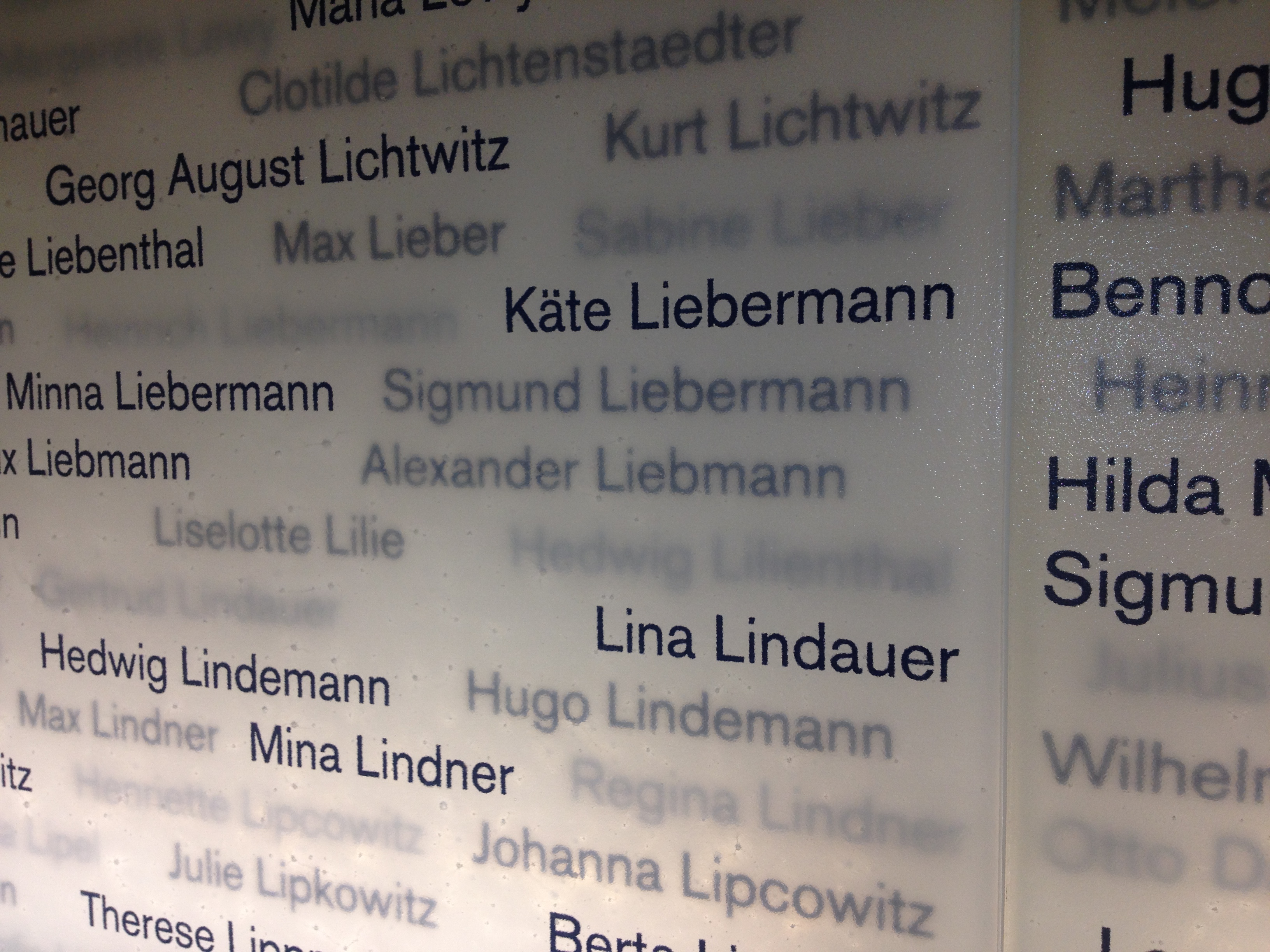
Liebmann was born on October 31, 1871, in Berlin, where he studied at the Berlin University of the Arts, even travelling to Paris every now and then for research. After working as a teacher, he fought for Germany in the First World War, rPicture by Tobias Dennehyeturning severely wounded and a war hero. His injury made it impossible for him to do most jobs that could have helped him make a living, but he and his wife were gladly employed by a friend as porcelain painters is his ceramic manufacture. When Alexander and Johanna Liebmann received a note on March 27, 1942, to be ready for deportation to a concentration camp on April 3 (simply for being Jews and after receiving the “Eiserne Kreuz 1. Klasse” and the “Hessische Tapferkeitsmedaille” for heroic services in the name of the same country that was now planning to kill them), the couple decided to leave together at least in the manner they decided themselves, if not the when: they committed suicide.

The rest of the tour was still interesting and informative, but it was always Alexander I saw.

As I was standing in front of the only remains of Munich’s former main synagogue which was burnt down by Hitler’s henchmen in June 1938: I saw Alexander there, praying, celebrating the Shabbat.

As I put on the Kippah to respect the house of prayer, I saw Alexander being harassed in his own city for wearing it, for believing.

As I was sitting in the synagogue’s front row, listening to details of the Jewish divine service rituals, looking up to see the last ray’s of today’s sunlight being refracted by Picture by Tobias Dennehythe ingenious metal construction that embraces the massive roof windows and suggests the form of the Star of David over and over: I saw the hope that had left Alexander and Johanna back in Berlin of 1942 – the hope that this place now radiates, for today and tomorrow.

Not only for the Jewish community, but for all of us, especially for our children, who need to remember, always, never forget, understand – and live to see a day when religion is a reason for joy, love and life, not the cause of fear, hate, and death. When the first four words engraved into the wall of the synagogue’s Path of Memory (“remember – mourn – commemorate – admonish”) truly lead to their four counterparts at the end of the tunnel (“learn – reconcile – speak – live”). A day when one of the questions asked after the presentation part of the tour (ironically by a little boy of maybe ten or twelve years of age) whether “Jews and Germans both come here, or only Jews?”, will not need to be asked anymore.

Picture by Tobias Dennehy

Back home, over dinner with the family, we all reported from our day: Chasing our friend’s dog along the banks of the Isar, returning home happy, hungry and tired – on the one hand. Chasing ghosts of the past along the Path of Memory, returning home tired, hungry, and happy to be alive today, to enjoy the fragility of piece with the ones I love. And being willing and able to remember the stories of the past, helping them create a better narrative for our future.

Next time, I think I’ll take my kids along …

When is a speech a story? When simply great rhethoric? When just utterly boring?

Tags

, , , , , , , , , , , , , , , , , , , , , , , ,

I had the privilege to be a participating part of the acclaimed DLD (Digital Life Design) Conference in Munich this week. “A global network on innovation, digitization, science and culture which connects business, creative and social leaders, opinion-formers and influencers for crossover conversation and inspiration”, the website says. And that it is.

First time ever for me. Its legendary reputation had traveled eons and light-years to my doorstep as the IT place (as in IT girl, not I-Tee) to be, if you’re even only remotely connected to the Internet and interested in the way digital life continues to change our analogue lifestyles. Worth every minute.

In many ways …

One of these ways I would like to spend a couple of lines on here. Not the networking, not the illustrious guests, the see-and-be-seen aspect or the really inspiring insights I gathered from almost each and every panel or presentation, not even the red-carpet, see-and-be-seen-even-more late-night party, although I quite enjoyed that one, too.

No, it’s the way speeches were held at this conference (as at most I’ve ever been to) and the very rare examples of good storytelling applied in these speeches that I will ponder over a little. I’m not talking about the contents, I’m talking about their structures or non-structures that are mainly based on power point hooks, not narratives. I mean, it’s really amazing: You have so many bright minds, freaks and geeks, young talents and old stagers summoned in one place for three days. They speak about their latest apps, business models, technology, their visions of the future … and all too often you can hardly avoid noticing that most of them do indeed have a story to tell. BUT: They don’t! They don’t apply any storytelling techniques to making their visions, facts and insights less bullet-pointy, less complete, but more compelling, more memorable, more narrative. There was even a panel on “Digital Storytelling”, a very promising title, but in the end merely a discussion over video formats, technologies, platforms and, again, business models. OK, maybe the latter is a very understandable and legitimate topic in a world where traditional businesses are eroding and everyone is desperately looking for straws to clutch at, but it’s not always entertaining for the audience.

So what did many of those speakers do wrong? Easy: They were mainly speaking facts, figures and features. And data and dollars. All in the name of the user’s experience (will always hate that defamation of a word for humans!), but it was mostly the experience of an arbitrary abstract being using technology they were speaking about. Not about concrete human beings, heroes or anti-heroes, their emotions, their dramas that led to the creation of this app or that service (even though maybe the rhetoric of many speeches was dramatic and good and suggested a narrative, where, however, there was none). And I’m not saying that they were not interesting or inspiring regarding facts and ideas transported – after all, you had preachers preaching to Catholics anyway, so ears and brains wide open. I’m just stating the lack of story narrative in the way they were presenting.

Although there were some remarkable exceptions to this rule – or maybe in the land of the blind, the one-eyed man is king?

Mahbod Moghadam, Co-Founder of www.rapgenius.com, a website that only at first sight is something for rap fans, actually unveils the curtain to probably every art’s and even every brand’s future. It allows fans and enthusiasts to make their own annotations to any kind of rap lyric, enriching it with their own stories that connect them personally, to a song and its content. “Annotate My Brand” was the title of the panel Mahbod was on, and he not only used his 45 minutes on stage and his youngster charms well to exchange business cards with Hublot’s Jean-Claude Biver and Missioni’s Angela Missioni. He most of all ignited the audience with his enthusiasm and the great stories he had to tell of the platform’s early days and collaborations with notable rap performance such as Jay-Z or Kayne West. name-dropping was maybe a cheap trick that helped, but his stories stuck. Left me hoping for the extension of his ingenious annotation site to my musical preferences as well as with the notion that: Not only as an artist, you’re work becomes a public good, open to recipients’ annotations; the same holds true for brands. Control is over. Your story isn’t your story anymore, it’s everyone’s. And everyone can and will use this opportunity, and that’s not a threat, it’s a great opportunity to crowd-source your own brand and your company’s reputation. Intriguing thought.

Then there was Ankur Jain, Founder and CEO of HUMIN, “a technology company working to make technology more human”, as his website says. And he started his speech perfectly in this sense: With a human story. With a hero (himself) and a “do you remember when” introduction, pulling the audience (at least those over 25) into their own past, enabling identification with a situation everybody knows: Once upon a time, it took you ages to find out the telephone number of a girl you were interested in, once you had it, you had to take a walk to the nearest telephone box to try to call her with your last coins (as you’re parents were kind of anal on the phone bill issue in the pre-flat-rate era), then dialing the number you had researched, waiting for the ring, hoping her dad wouldn’t pick up the phone, then he did, you hung up, money gone, off back home. Just an anecdote, maybe, but a good, personal intro into explaining what his app was supposed to do: seamlessly connect you with all your contacts on all your various social platforms and address books. Left me entertained and willing to download his app and try it. Which I did.

Or Whatsapp’s Co-Founder and CEO Jan Koum. His visions for his very successful messaging service as well as the sympathy level for him as a person and his work stayed on a low-level for me, even though I love his app, UNTIL: He told the very touching and comprehensible story of this young man emigrating from Ukraine to the USA who missed his parents and family so much, but couldn’t afford regular calls, let alone trips home – so he invented Whatsapp to stay in touch with the people important to his life, instantly, whenever, and economically. I bought into the idea and rationale, and understood even better why I make such frequent use of this little green tile on my iPhone.

What I’m getting at, and what is my personal take-away from three days of insights into digital trends for life and business and business life, is best summed up with one of the many great quotes of one of the great lost storytellers and story-understanders, Steve Jobs: “No matter how good the technology, it will not turn a bad story into a good story.” [http://goo.gl/H1ZCuy] Or a bad speech into a good speech, I might add.

So I’d like to end this stream of thoughts with two videos that are better tutorials for a good speech than anything I could write here:

Steve Jobs’ legendary 2005 Stanford Commencement Address, which is any prime example of perfectly structured story-in-speech, not filmed, not written, but spoken aka told (even if not off by heart, but from the heart). Three little stories turning into one big story at the end, leaving a clear message without needing to name it. Please enjoy this one from beginning to end:


And this more tutorial-like video by Nancy Duarte, an American writer and graphic designer, well-known for her two best-selling books “Resonate: Present Visual Stories that Transform Audiences” and “slide:ology: The Art and Science of Creating Great Presentations”. A very nice summary of how you can mix pure facts with story in a power point, as you mostly need to do in business presentations or speeches, nevertheless not bore to death with report style, but also not get lost in anecdotia or storyland.


So, what do you think? Agree? Disagree? Why?

In any case: I’m happy to see you again soon, here, where the story goes on … soon.

Stories worth watching … #3: Old Spice

Tags

, , , , , , , , , ,

When are you old? When you grow grey hair? When your six-pack turns to pudding, your “V” into a pyramid? When you can’t become twice the age you are anymore?

When you start using Old Spice?

C’mon! Which man under the age of 150 would use this auld odour, the smell of which used to make your wrinkles multiply within a nostril’s movement?

Or so I recalled.

I confess, I’ve tried the spice, just recently. And I totally blame ONE person for this: The “Old Spice Man” telling his imaginative, fairytale-like series of quick stories (or advertisements, as the vulgar tongue might call it) of “The Man Your Man Could Smell Like”.

Almost three years after the campaign’s launch and maybe a year after I became seduced by these funny and promising Old Spice Man stories (and stories they are, even without an classical plot within the 20-30 seconds, but the promise of one hidden in every one), I decided to believe the fairy tale, standing in front of the shelf of my local drug store, suspiciously looking over my shoulder for friends (or foes) witnessing my imminent bold (and maybe embarassing) action … and let a sample of Old Spice’s new “Wolfthorn” deodorant slip into my shopping cart, put it on the cash desk conveyor belt like that young fellow in the old condoms ad you might remember – and into my bag.

A day later, trying it on at home, I found out: It works! The story IS true!

Why? My little eight-year-old daughter came up to me and said: “Dad, now you smell like a real man!”

True story, this.

So, and since there is always a moral to a blog, here we go:

Contradicting my beloved Cluetrain Manifesto’s 74th thesis claiming that “we are immune to advertising”, I do believe, in the name of the wolf’s thorn, that advertising does still work, even today, at the end of the one-way age of broadcasting. IF it tells a story, offers or promises a plot, implicitly or explicitly, but never violates the storycodeX of EXPECTATION, SURPRISE and CHANGE as the constant beads of its narrative chain. And if you find out afterwards that the ad didn’t promise heaven on earth, but actually offered you an element of truth you could verify through your own experiences with the product.

Which I could. OR is there a more convicing truth out there than the one seen through the eyes of a child – or better: smelled through her sensitive nose? 😉

What’s reassuring: I’m not alone (47,475,478 views and 41,348 comments on the first spot alone). And if you search for “old spice sales after commercial ” on Google, you can find out that the campaign is not just a viral and image success: sales increased by 107% alone in the first twelve months after the launch of this commercial. Not bad, old man!

So, what do you think? Agree? Disagree? Why?

In any case: I’m happy to read your voice and see you again. Here, where the story goes on … soon.

Stories worth watching … #2: Jaguar

Tags

, , , , , , , , , , , , , , , ,

Somewhere in the desert between America and Mexico. An endless black asphalt snake slithering through an intimidating vastness of brown, dry, merciless mountains. On the snake, in the distance, a car on the move. You can see (and somehow feel) the heat, the sun shimmering on the desert street. Suddenly, a man (or woman?) with a black motorbike helmet, steps out of the shadow of a rock prominence, observing the (now revealed: red sports) car. Screeching dirt-bike tires, a blinding smoke of sand, the motorbike drives head-on towards the sports car, at the last minute avoiding a collision. Bike and rider slide along the asphalt, bringing the car to a halt, and its driver to get out of the vehicle and check the seemingly unconscious biker’s wellbeing. BANG! The biker grabs the sports car driver and …

“One man. One job. But in the desert, nothing is simple.”

That’s what the video’s subline says.

It is nowhere, I’d say. But certainly nothing is what it seems in this very intelligent, bold and entertaining piece of corporate advertising about a man driving a very desirable convertible sports vehicle through the desert towards Mexico, meeting a beautiful woman who jumps into his car on the escape from her kind of choleric, overly protective, gun-loving, probably violent drug cartel boss husband. Who in the end catches up with them, and then …

Before we go on, you should enjoy the piece, and don’t let the length discourage you, it’s worth every second:

http://www.youtube.com/watch?v=O-uvmDlG_9s

So what makes this piece of moving image that Jaguar had produce for the launch of its new F-TYPE sports car called “Desire” a true, well-told story? A story you (or at least I) desperately want to follow to the end – despite its epic 13:24 minutes (for me great counter evidence of the alledged commandment of brevity for content on the web)?

And to take the wind out of all those whining marketers’ “we don’t have enough budget” sails: It’s NOT the fact that it’s a Ridley Scott Associates production. It’s NOT the fact that it has Golden Globe winning actor Damian Lewis as well as Shannyn Sossamon and Jordi Mollà performing brilliantly in this film. And it’s NOT the great score including a song by BRIT award winner Lana Del Ray. Granted, it may help to have someone direct your advertising who knows his craft as a storyteller, but being good is not a question of budget.

For me, the following points make “Desire” a good story – or a story at all:

  1. Plain and simple: It has a PLOT. Aka something is happening, something changing for the better or worse. On the broad scale of the overall almost quarter hour drama (“Man to deliver luxury car to wealthy client somewhere in the Mexican boondocks”), as well as in many micro-dramas along the way, e.g.: biker seizing car driver; woman hijacking car and driver; driver realizes the man he is supposed to deliver the car to is the man trying to kill him; the driver’s decision, not to deliver, but to help the escaping women; and so on, and so on.
  2. It plays with the essential ingredients of story in the classical way that every great film, book or speech ever created does: EXPECTATION and SURPRISE. You want to know how the story ends! A story which simply is fun, not only because there’s lots of action scenes (which we men love), and some maternal-drama-meets-forbidden-love elements (which woman love, and men, too, c’mon, be honest, guys!), some nice grains of British humor lightening the tension between the protagonists, very well supported by a great musical score). But mainly because you want to know what happens next, and next, and next, and in the end. So, in a classical action-meets-love-story way, in terms of storytelling: nothing novel, not much innovation. But: In the respect of consequently integrating this into business storytelling and product adverising: indeed innovative. And intelligent.
  3. Speaking of intelligence: I recently wrote, and would stick to this over and over again, that nothing is more boring for the recipient of a piece of business communications than a bleeding list of product features, benefits and what have you. But this film quite impressively shows us that, if you intelligently weave your “corporate messages”, your product’s miraculous features into a story: it can work and even be fun to listen to them. And, most importantly: You believe them! I mean, can it get any better than from minute 09:30 to 10:55? You (or at least I) actually believe Mr. Martinez when he says: “Now that’s a good car!” Within the plot, it does indeed seem credible that this paranoid mad man would detour from the most suspense-packed part of the story, the live-or-die, keep-or-lose-wife climax, by asking for the features of the car he ordered. The story stops for advertising, which you hardly notice at first, and when you notice, you like it, you bow your head and think: “Damn, if I could afford it, I’d go right out there and buy me one!” Or at least I do. 😉

So, what do you think? Agree? Disagree? Why?

In any case: I’m happy to see you again soon, here, where the story goes on … soon.

“What IS story? And what ISN’T?” … Part 3: The Truth Aspect

Tags

, , , , , , , , , , , , , , ,

“Never let truth get in the way of a good story.”
Nucky Thompson

Now that’s a sledge hammer statement, I’d say.

More truth behind it, however, than you find in most of the business “stories” out there, that’s a fact. A truth that’s just as old as story itself. Especially in the context that Steve Buscemi’s character utters it in Episode 1 of Terence Winter’s and Martin Scorsese’s no less fascinating mob series “Boardwalk Empire” – which is politics.

Unfortunately, this has no less been true for the sphere of economics and business ever since we started to trade mammals for firewood way back in the days – or bonds and shares for lies on Wall Street just recently. And as we all know, business is nothing but politics, so in a way you could say that corporate messaging is suffering the same slow death as capitalism is, or at least the locust version that brought down the Lehman Bros: People don’t buy it anymore! They want (cognitive or emotional) proof, either from
– own experience
– a friend’s recommendation (or disapproval), or
– a gut feeling that a corporation is telling a true story.

And the latter gut feeling can, today, always be unmasked as false by a friend’s or so-called “user’s” – what an irrespective word for a person getting in touch with your corporate content, I’ve always hated it … just a gut feeling … 🙂 – disapproval, or also own experience. Recapitulating: Social Media = Storytelling and Social Media unmasks every corporate lie aka bad messaging story attempt, sooner or later!

OK, but: truth is not always the same in good and true storytelling. The way I see it, there are two dimensions of truth in story:

Authentic / documentary / historic / objective / non-fictional truth
This is the kind of obvious truth we all know: What is told in a story (film, book, theater play, you name it) is indeed authentic, i.e. it REALLY TOOK PLACE. The protagonist is A REAL PERSON whom we are either witnessing during a positive or negative, but in any case dramatic (in the literary sense) part of his life that is at that moment REALLY TAKING PLACE – or who is acting as a witness of this drama that REALLY HAS TAKEN PLACE sometime in the past. The classical documentary. There is a truth behind every documentary that we can investigate (if we find time and pleasure to do so), that we can prove or refute. Any well-told and well-researched history book or TV program falls into this category as much as any animal documentary or social reportage.

Inner-fictional logic and subjective truth
If objective truth was the only dimension of truth that made a good story a true story, then all Hollywood films, all great novels of literary history, every poem, every comic, etc. would be “un-true”. Which they are not. They all have an inner logic, an inner truth which they follow to the most meticulous extent – if they are well-built and well-told. Everything COULD HAVE TAKEN PLACE the way it is described, the protagonist COULD HAVE existed and experienced the described drama, even though in another or maybe even a fictional world.

Take Garcia Marquez’ “Love in the Time of Cholera” – one of the greatest love stories of the 20th century – as an example: Young Florentino Ariza and lovely Fermina Daza COULD HAVE really fallen in love with each other, secretly living this forbidden love through an orgasm of passionate love letters despite the forced separation by Fermina’s father. Florentino’s love COULD HAVE kept growing ever fonder and deeper and undying despite Fermina’s marrying handsome Dr. Juvenal Urbino, at first under arranged circumstances, then with real affection and love, which led her to exclude her former lover Florentino from her life. And after almost a century of undying, in fact evermore flourishing love to this evermore unreachable lover, Florentino COULD HAVE waited all those years for his true love, and the two of them COULD HAVE met decades later after Urbino’s tragic death to renew their old love just before the end of their lives, on an old Mississippi steamboat …

51e2eOuVQBL._SY344_BO1,204,203,200_

Gee, I’m getting carried away … you SHOULD read this book, true recommendation! Simply reliving the memory of reading this novel gives me goose pimples, although the plot is of course fiction, it did NOT really take place, but it is so well told that I am convinced it COULD HAVE – and maybe has?

What I mean by all of this and what Florentino’s ordeal d’amour has to do with business story: In general, a real and good story can have either an objective, provable plot, or a truth made true by the inner logic of a fictional narrative. Both need not only the classical elements of story structure (a future post on this blog will elaborate a little more on this aspect, rest assured!), but also a capable narrator.

OK, and this is where most business stories fail, miserably:
– First of all: They have no story structure
– Then: They very seldom make use of capable and experienced narrators and storytellers; they rather use brain-washed, submissive agencies or brain-washed, inexperienced employees
– They – what is worst in the context of truth – mix truth (real people like employees or customers and real products) with fiction (corporate messaging bullet point as pre-scripted storyline and treatment structure elements that claim to be authentic) without transparently distinguishing the blurring barriers for the viewer or (abused) user.

So, to come to an end here:

If you’re a business storyteller, stick to the truth and nothing but the authentic, documentary, objective and provable truth.

If you’re a screenwriter or novelist or poet or painter or whatever artistic inventor of truths, make sure you adhere to the inner-logic of this fictional truth. But you can also – and that’s kind of unfair – not only invent truths, but also combine invented truths with real, authentic, objective and historically provable truths and still tell a great and credible story. Grrr, damn these artists!

But then again: Life ain’t fair, so get over it, oh Business Storyteller!

And if you DO mix objective truth with fictional elements, you better be as intelligent, bold and open about is a the desirable brand Jaguar in their recent advertising feature film for its new F-type model called “Desire” – a “story worth watching” I actually wanted to write about today, but to tell you the truth: I got carried away with writing about truth. 😉

Very well then, I’ll do that next time, because:

The story goes on … here … soon.

Video

Stories worth watching … #1

Tags

, , , , , , , , , , , , , , , , , , , ,

“Year after year, power cuts threatened the Yang’s orchid farm. Now is their last chance to save this fragile business. But it has been a long, cold winter in Guangdong…”

This is the brief, seducing intro to a very touching story about Mr. Yang and his family who are in the business of selling orchids in the Chinese province of Guangdong. The orchid selling season is running to its peak around Chinese Near year when the story begins. Normally, that’s a very exciting and promising time of the year. However, Mr. Yang is as nervous as never before, for him it’s an all-or-nothing year. In past seasons, his fragile flowers have suffered from frequent blackouts – and no power means no delicately heated greenhouses, means no flourishing orchids, and means no income for the Yang’s. This season is the very decisive one for the family and its business …

If you want to find out how the drama ends and what all of this has to do with a German engineering company, you should follow my recommendation and enjoy these six minutes of very emotional and intelligently story called “The Last Flower”, told by award-winning US documentary filmmaker Zac Murphy for the digital storytelling magazine “/answers”:

Some background on “/answers”: In 2010, while other B2B companies were still dreaming the twentieth-century broadcasting Muezzin’s dream, Siemens had the courage to experiment with the evil twin called “loss of control”. They asked renowned documentary filmmakers, journalists and authors from around the world to take their personal look at people who benefit from Siemens technology, mostly unknowingly. Every author is asked to find true heroes for a true, authentic, un-staged story, people who have or have had a major challenge in their lives which they manage(d) to overcome. The authors produce a piece of authentic story (not always necessarily film) in their own style and tone of voice, no branding, no company control of the creative process or outcome. I still think that’s pretty brave and remarkable.

/answers has been the experimental and at the same time very thought-through and dedicated top of my business story list for a very long period of time. The magazine was launched in 2011 at http://www.youtube.com/answers and http://www.facebook.com/answersmag and includes two new stories every month and lots of interesting background info and behind-the-scenes outtakes on the Facebook page. Worth watching and following!

BUT: Ever since, the business (2C or 2B, a very questionable differentiation anyway) communications market has moved deeper into the sea of stories and invested more time, effort and money into this social media currency – which is great and raises hope. Have a great example from Old Spice up my sleeve for the next post …

Stay posted, because: The story goes on … here … soon.

“What’s IS story? And what ISN’T?” … Part 2: The Human Touch

Tags

, , , , , , , , , , , , , , , , , , , , , ,

Just before tradition forced me to vanish into a (non-white, sometimes rainy, sometimes spring-like warm, but very nutritious) Christmas break, I had touched upon the human touch of stories. In my eyes one of the most amusing and annoying misunderstandings in today’s business communication, the “human element”, right …

A misunderstanding that started off with two seemingly positive and delectable developments, for privateers as well as inside corporations great and small:

  1. Technology (once again), especially the ubiquity of HD-ready devices:
    Just a couple of years ago you needed a real pro with a real pro equipment to produce a pro piece of film for you, privately or as a brand. But today: Camcorders, digital cameras, even smart phones, available at reasonable prices, easy to handle, one-button simplicity and … Tadaah! Here’s your great video! Or at least a moving image with an .mpeg or .mov or .whatever file ending. Or at least something that conforms to the minimum standards of standard video players and standard video platforms. But does that make it a good video, let alone a good, interesting, appealing, relevant piece of communications collateral? More on the nay side, I would say.
  1. Storytelling, the latest magical bandwagon for marketers (and bloggers, haha!) to jump on, mostly without a valid ticket, let alone a driving license:
    I remember, Hippocampus, here we go again: It was some time in the winter of 2008, I was invited to give a 15-minute impulse speech at a conference of top communications managers from all over the world, about the potential of storytelling in business-to-business communications. Very few slides. No flow charts. No processes. No figures. That already scary enough for advertising dinosaurs and communicator-wannabe engineers. Just a couple of quotes, trying to give them an idea of what the heck this humanist and literary scholar was a) doing here and b) talking about. After my 15 Warhol minutes and some drinks at the hotel bar: I thought they had gotten the idea, theoretically.

Unfortunately, I was wrong, I had failed. It turned out that the distilled gist they had taken away was not plot, change, suspense, surprise, conflict or other story dynamics of that kind; it was “the human element”. Not a bad thing at all, don’t get me wrong, and surely a valuable ingredient for a good story full of identification potential and stuff, but: If you think putting one or two humans onto screen, slide or paper turns messaging into story: wrong end of the stick.

Example one:
Interview your real Sales manager human being in front of his real product for a real product website talking about the product’s really great features: Ain’t no story.
Change of approach: Find out who this Sales guy person is, where his passion comes from, what he’s been through to get to where he is today, what he loves to do in his leisure time which might in a way be related to the benefits of his great product? More like it, story-wise, at least some potential story angles there.

Example two:
Show a real cute girl patient in a hospital climbing into a CT scanner, two grown-ups with concerned looks on their faces, underlay some emotional music and a compassionate voice over for a 30-second TV spot: Ain’t no story.
Change of approach: Dig deeper and tell that girl’s (hi)story, her ordeal, the ups and downs she and her family had to go through until they finally found a way to access this unique, life-saving medical device … Bang! There’s your story!

Let’s add another perspective to this human element thing:

Do you think you could lament for the fate of an ant?
http://youtu.be/jB8wKvI0_8E

Could you anxiously witness every minute of a toy’s story?
http://youtu.be/7MM1k1SSlWs

Or an alien’s?
http://youtu.be/_7-2PB4jj2o

Or a machine’s?
http://youtu.be/9rlI3Xg9g_A

Gee, took me long to get my thoughts together here, must be the turkey still weighing on my concentration … so, what I’m getting at:

  1. You don’t need a human being for a good story, you need an element of humanity. And there are many business communication products out there with many humans, but lacking humanity, hence: They don’t work.
  2. Whoever is the hero of your story – man, machine or animal: Whatever happens to him (or her) needs to resonate with human emotions, needs to offer human identification, needs to feel humanly familiar.
  3. Oh and – I may have mentioned it before: Something needs to actually HAPPEN, before you decide whom it happens to.

Yet, the good news at the end of a long post and year: There’s hope and quite a number of really interesting storytelling projects out there in the business world already, rays of hope in a dark, loud and boring corporate messaging world.

So, I’d like to start 2014 with my personal top 5 selection. Permitted that New Year’s Eve is gentle to me …

In any case:

The story goes on … here … soon.

“What IS story? And what ISN’T?” … Part 1

Tags

, , , , , , , , , , , , , , , , , ,

Went for a walk this morning (well, wasn’t really morning, but pretty much felt like it) and maybe it was the unexpected and unwonted amount of oxygen rushing through my synapses, but: After about half an hour of contemplating over the best way to maybe start a series of “What IS story? And what ISN’T?” posts, the plethora of oxygen carried my Hippocampus back 20 years in time.

Back to my first days at university, just after the first intro session with my future literature science professor, where he answered every freshman’s burning question “What should a Germanist read?” with a brief but sharp “Everything!”. I’ve tried for the past 20 years, I really have, but …

See what happens when you get too much oxygen and stuff??? What I wanted to get to is: Just a semester or two later, I was able to counter and at least give new first-semesters two answers to the question “What are the most important things you will learn during your studies?”:

  1. Secretaries are more important than professors.
  2. You don’t need to know a lot, you only need to know someone who knows or somewhere to look it up.

… And suddenly, after about 45 minutes of absent-minded walking, I knew where to start. With my man Kurt Vonnegut (humanist, pacifist and influential “counterculture novelist” of the twentieth century, as the NY Times called him after his passing in 2007) who probably indirectly gave the most accurate and at the same time most entertaining definition of story and non-story that at least I have seen or read to date – and remember: I haven’t even come close to my professor’s everything goal!

Take time for and enjoy these 4:37 minutes, they’re worth every invested second.

My lessons from this piece of infotainment are (business people hear, hear, we got some lessons learned, bullets, and guidelines coming your way right here):

  1. Stories move in waves. Every piece of content that doesn’t move beyond the B-E Meridian is NOT a story.
  2. Acknowledge the Negative. Either as starting point, turning point, climax or – and that scares the shit out of Hollywood as much as the Marketing work – as denouement.
  3. With the words of one of the world’s most acclaimed screenwriting lecturers Robert McKee: “Essentially, a story expresses how and why life changes.” (http://hbr.org/2003/06/storytelling-that-moves-people/.Meanin)g: No change, no drama, no story. A flat B-E Meridian has the same consequence for a story like a flat ECG wave for a human being: It’s dead.

Oh yes, human … that’s another marketing must of the last couple of years. Show people in your video, and there you have a story. Yeah, right.

Why it’s not quite as simple as that, but much more rewarding when you go the hard way, and why this is just the tip of the storyberg: Next time.

The story goes on … here … soon.

Markets are Conversations are Storytelling

Tags

, , , , , , , , , ,

It’s already a couple of years ago that I was taking my kids to the „Deutsches Museum“ in Munich, Germany. Of course, the attraction for little girls is less the impressive planes or ships, let alone any technical innovations of the past or present. The burner: The interactive technology experience playground down in the basement. After hours of deafening children’s screeching and soaking wet from these lovely water games, I announced: “Now it’s time for some REAL culture!” taking them up to a special exhibition about life in the 1950’s.

Old cars, vespas, vacuum cleaners and washing machines, strange dresses and shoes and sun glasses … all nice, my girls giggling, me becoming Mr. Nostalgia. BUT the following scene from that day is what made this exhibition so rememberable for me: A roughly 12-year-old boy standing on front of this ancient TV screen, massive with a greenish screen and classic wooden shells, when I overheard the following dialogue:
Boy: “Wow, they surfed the Internet with these things?”
Mother: “That’s a TV, back then, there was no Internet.”
Boy: “What do you mean: There was no Internet???”

Interesting. A generation that was born when the Internet was already mainstream standard. A generation that can’t remember having to walk to distant telephone boxes in the freezing cold to speak to your girlfriend, back then when there was no Skype, no What’s App, no Facebook or phone flats. Only 20 years ago. A generation that was born just before the 2001 .com bubble crash, around the time when four fare-sighted guys /Rick Levine, Christopher Locke, Doc Searls, and David Weinberger) from the U.S. hammered their 95 commandments to a digital wall named www.cluetrain.com.

cluetrain.com

What this has to do with storytelling? Everything. Let me mark out just a couple of Cluetrain theses which I believe significantly direct business humans working in and for corporations and especially in marketing and communication departments in the right cardinal point, directly to the power and inevitability of story in the social web age:

“Markets are conversations.” (Thesis 1)
The boiled-down essence of The Cluetrain. Meaning: “Markets consist of human beings, not demographic sectors.” (Thesis 2) Meaning: Target groups, clients, users, readers, viewers are humans. Not some alien, abstract mass of lemmings waiting for a message to follow. And these markets (or humans) are constantly engaged in conversations, with each other, with other corporations – and conversations are meta level of stories, or vice versa: stories are the molecules of conversations.

“People recognize each other as such from the sound of this voice.” (Thesis 5)
If that is so – and it is –, then corporations can’t talk, can’t tell stories, can comment, can’t post, chat, respond or share information, only their employees can. And no products, no solutions, no services, no companies can be heroes, only people can – and in the sharing web that finally really helps Kant’s Aufklärung blossom, corporate fake will be unmasked in the tweet of an eye. And “as a result, markets are getting smarter, more informed, more organized. Participation in a networked market changes people fundamentally.” (Thesis 10)

“A powerful global conversation has begun. Through the Internet, people are discovering and inventing new ways to share relevant knowledge with blinding speed. As a direct result, markets are getting smarter—and getting smarter faster than most companies.” (Thesis 75)
There’s nothing to add here, they wrote this in 1999, and look at many companies, especially in the B2B area: They’re still lagging behind on the smartness front like ever before.

Last but not least, the bulls-eye thesis for the importance of storytelling in the technically interconnected world:
“If you want us to talk to you, tell us something. Make it something interesting for a change.” (Thesis 75)

And this “something interesting” is an interesting, relevant, credible, authentic, true story.

And what IS a real, true story? And what ISN’T?

The story goes on … here … soon.

Social Media = Storytelling

Tags

, , , , , , , , , , , , , , , , ,

Recently at a conference, someone asked me why the hell everyone in business is talking about the need for this new thing called storytelling in communications and marketing. First of all, I told him, I’m happy that they are finally getting it. Or are they? If they call storytelling ‘new’, they surely aren’t…

Thing is: People, and I specifically mean business people, think that a little bit of emotional music, a couple of real humans and a raw look and feel makes a piece of communication authentic, relevant and, yes, a story. Ever heard a colleague come up with a “great story” he wants to write about, or show you a video that portraits “our unique story”? And once you take a closer listen or look, you hear or see nothing but a paraphrased or moving-image message triangle, patronizing the recipient in 20th-century advertising manner, telling him what to think or feel or, in the end, do. No hero, no drama, no expectation, no surprise, no identification.

The great thing about today: In the digitally connected world, people are getting back to the roots of human conversation, gagging for true, real and surprising story, something outstanding, something new to enjoy and share. Ergo: This whole social media thing is nothing but an extended remix version of an old, very successful song.

Why’s that?

Well, sharing aka telling stories has been man’s unique selling point and leisure pleasure ever since he (or she) could communicate (non-verbally or verbally) – around campfires in the Neanderthal or at medieval markets, at children’s bedsides or you name it. In other words: being social, embarking into (however purposeful) conversations with other people. Sender tells, recipient receives, recipient becomes sender, becomes recipient, becomes sender and so on. Being social is having conversations, and conversations are never one way. In the vernacular we call this: Dialogue. Thereby follows Equation #1:

Social = Conversation

And if this is so, that being social and having conversations is the most ancient human trait we can think of, what makes social media or the so-called web 2.0 so special, so revolutionary? Again, easy: Technology. Whenever mankind creates something big, it’s either mimicry or an enhancement of what nature already has in store. As in the case of the Internet and its second-generation 2.0 version, technology has enabled us to bring human conversations from a personal to a global (and sometimes hence impersonal, but that’s a different topic) level. Leading me to Equation #2:

Social Media = Global Conversation

After all this, the end (or beginning?) of this story (or message?) is no rocket or internet science, it’s mere logic: If we only embark in conversation with people that have something interesting to tell, something we can relate to, something that touches either our hearts or our minds or both, the power is not in great rhetoric or bullet points of a fact sheet. It’s the stories we hear about real people with real challenges, real successes, real failures, yes: real lives. Why should this be different in social media’s global conversations? So in the end comes Equation #3:

Social Media = (Global Conversation =) Storytelling

If this is so – and I get a strange feeling I’m not completely wrong here –, then this is just the tip of the iceberg when it comes to successful communication and marketing in the 21st century, be it for a company or your own personal brand. Like: What is and what is not a story? Where the roots are and what can we learn from them? What do Aristotle and the Cluetrain Manifesto have in common?

The story goes on … here … soon.