• home.
  • blog.
  • storytrain manifesto.
  • stories.
    • songs.
    • /answers.
    • poems.
  • publications.
    • articles & books.
    • videos.
    • interviews & reports.

storycodeX

~ The art of story in life, business and business life.

storycodeX

Category Archives: experiences

Need to exchange unwanted Easter presents? “Story Cubes” is the perfect choice!

15 Tuesday Apr 2014

Posted by Herr Dennehy in experiences, What is STORY?

≈ 1 Comment

Tags

change, easter, expectation, narration, story, story cubes, Storytelling, surprise

It’s a crux with these holidays: When you think they’re finally over, the next one is just around the bend. Christmas, birthdays, Saint’s Days, … and Easter. Just around the corner, again.

And even though our beloved Easter bunny (apparently) has limited storage capacities (unlike Santa with his big sack), there are somehow always some small oder medium-sized toys (so-called SMT’s) that find their way into the nest where only chocolate rabbits and sweets should be.

But what if good ol’ Bugs accidently brings a duplicate or something unpopular, something endlessly uncool?

No worries, I have a replacement recommendation for you. I mean for Mr. Bunny, of course.

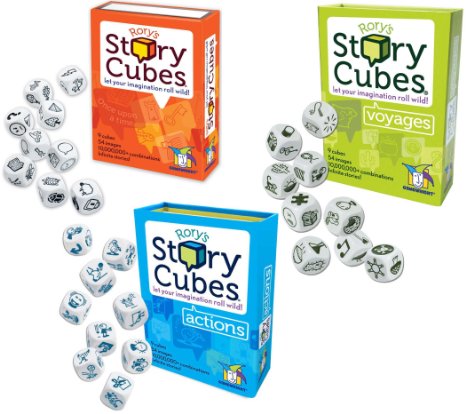
It’s called “Story Cubes”, a simple, entertaining, educating game, and it’s about pure storytelling. The packaging says: “Age 6+”, but it also works with younger children, showing us once again that storytelling is a human gift, engraved into our DNA, a pure form of human communication behaviour for which you need no education, no theory, just infant practice.
 

storycubes

“Story Cubes” currently comes in three variations: the “classic” version, the “actions” version, and the “voyages ” version. You can play any variant on its own or randomly combine them.

It goes like this: There are 9 dices (aka cubes) per story cubes set, and every side of every cube carries a different image, like a monkey, the piece of a puzzle or a camera, for instance. The player whose turn it is throws all nine cubes at once. He then needs to bring the cubes into any given order by chaining one image to the next – like chapters of a story. While doing this, he tells the plot of the story he is just laying out on the table – the drama that turns the images from mere symbols into the different acts of a story. This can be short and sweet, or long and epic, depends on the player’s narrative breath and imagination.

What is interesting: The game has no winner or loser. It’s just about telling good, entertaining, surprising stories. Especially for children, but also for us grown-up’s, there’s a high level of creativity and imagination required, in order to have fun and entertain your fellow players.

Plus: You can’t fool kids like you can fool inapt managers or other advertising- and PR-spoilt business individuals: you can’t put anything over them, can’t simply chain one image or word to another and claim it’s a story, when it’s nothing more than bullet points or corporate messages (to stress the manager metaphor once again). And I made the experience, while playing Story Cubes with my daughters, that the infant, naĂŻve rejection of a boring, plot-free succession of words not only happens when they are forced to listen (aka as audience), but also when they are the storytellers themselves. They actually interrupt themselves with the comment “Can I start again? This story is boring, nothing’s happening!”

That’s how they learn the craft – and intuitively follow the StorycodeX of Expectation, Surprise and Change. A CodeX that also needs another vital ingredient, the Hero or Protagonist who this surprising change is happening to, always an organic, unwitting part of my kids’ Story Cubes stories …

But I’ll write about the Hero Phenomenon in a later post – when I’m back from my Easter Holidays, NOT playing Story Cubes, as the rest of the Mr. Bunny’s presents were indeed a slam-dunk. 🙂

Share this:

  • Click to share on X (Opens in new window) X
  • Click to email a link to a friend (Opens in new window) Email
  • Click to share on LinkedIn (Opens in new window) LinkedIn
  • Click to print (Opens in new window) Print
  • Click to share on Telegram (Opens in new window) Telegram
Like Loading...

Confessions from a Breakfast Table

14 Monday Apr 2014

Posted by Herr Dennehy in experiences, hiSTORY

≈ 5 Comments

Tags

Adel Tawil, Authenticity, Bangles, Beck, Bob Dylan, Boys 2 Men, Bros, change, Cutting Crew, David Bowie, Depeche Mode, drama, Elton John, EMF, expectation, Guns N Roses, Herbert Grönemeyer, Jimi Hendrix, Kurt Cobain, Lieder, listening, Louis Armstrong, lyrics, memory, Michael Jackson, Music, Nirvana, Prince, Prodigy, Rio Reiser, songs, Storytelling, surprise, Witney Houston

OK, I have a confession to make.

And this is really not an easy one.

So … There is this German pop singer. I really detest his banal, friendship-book-like lyrics, his schlager music style, hate his “I am your favorite son-in-law” attitude. Gives me goose pimples on my eardrum. Kind of my Lord Voldemort of Music, he who must not be named, let alone listened to.

But then something happened and forced me to reconsider … grrrr!

Crime scene, once again, the breakfast table. Sitting together with a little spare time, on our plates all the things children do that have the potential of becoming the source for an unexpected change of perspective. The girls had been singing this song called “Lieder” (“Songs”), My Musical Lord Voldemort’s latest Ĺ“uvre, for days, almost off by heart. The song had also been permeating my sensitive auricles for weeks, in shopping malls, as background purring in soap operas, or on 40+ radio stations day in, day out, perpetrating the notion that the Lord was doing it again. Ooops style.

The girls’ tweeting at the top of their voices, knowing the lyric’s word by word, if not the meaning, forced (and continues to force) me not only to damage my Spotify playlist image, but also watch the guy’s very unsubtle video on PutPat like a trillion times in a row, and listen a little closer.

Now that really ticked me off! Liquid substance coming for from my lachrymal sacks listening to this kitsch? Ah, c’mon! For no rational reason at all: The melody is mediocre, the arrangement and production middle-of-the-road pop, the lyrics far from anything poetic, intellectually ambitious or sophisticated.

BUT … Voldemort is, in these 3 minutes and 50 seconds, well, not actually telling a story, but implying one. The big story of collective memory, brought to life through a vast number of song titles from the past decades of pop culture. Every single one of these titles hints at a very different memorial story in all the different hearts and minds of its listeners, snowballing emotions that the narrator may be hoping for, but surely cannot know or predict.

It’s a cheap trick, and not particularly well done, judged with the rational part of your self, but it works, with the emotional half. If you put aside your intellectual coolness barrier and let your thoughts take this trip down memory lane. Unbiased and, yes, with the eyes of a child – which is quite fitting in the case of “Lieder”, as most listeners who allow retrogressive tears to well up here probably were in their infancy or adolescence when the mentioned songs were in the charts or en vogue, hence surfaced from the masses of music to become music for the masses and memory makers for many an individual. Including me.

The songs that “Lieder” refers to can be found in the following playlist, and I BET you, you’ll be kick starting your hippocampus within seconds, with images that are completely different from the ones that I have, but I betcha they are there, if you allow them to.


And here’s the list in words, just for the record.

So what do I take from my own personal Lieder Experience, apart from a couple of pudent tears?

Our lives are indeed made up of stories. Not facts, dates and names, it’s the stories that make all of them come to life and live on in our memories, no matter how much time has passed. We will forget the names of people we went to university with, forget the bad marks we got in school, maybe even the name of the girl who dumped us when we were 14. But we will never forget the song that was playing on the radio, on our Sony Walkman or from the loudspeakers at a youth club party when we were feeling sorry for ourselves for whatever reason. Or happy. Or whatever the feeling was. And behind every feeling, there is a story.

So whether it’s Walk like an Egyptian, When Doves Cry, Voodoo Child, Like A Rolling Stone, Just Died In Your Arms Tonight, Bochum, Don’t Let The Sun Go Down On Me, What A Wonderful World, Dancing With Tears In My Eyes, Heroes, Unbelievable, Purple Rain, Firestarter, I Will Always Love You, You Are Not Alone, Welcome To The Jungle, Personal Jesus, Insane In The Brain, When Will I Be Famous, König von Deutschland, End Of The Road, Loser, Killing In The Name Of, or Come As You Are … there’s probably a million stories secured in a million hearts and connected to one or more of these songs, maybe even one or more per specific lyric line.

And that’s the sole, but powerful beauty of “Lieder”.

No, allow me to correct myself, there is indeed another beauty to it: It makes me look forward to the day when my two little ones are big and (hopefully) interested enough in all those pearls that He-who-must-not-be-listened-to is singing about, maybe even like one or the other song or story. And probably the song “Lieder” itself will, whether I like it or not, become a new link in my chain of songs worth remembering – not because they were especially great, but because they remind me of special moments of my life.

Like sitting at the breakfast table, morning in, morning out, with two little voices of Germany listening to, watching and reciting  this tune, regardless of the tight schedule before school-kindergarden-work. And reminiscing stories, thoughts, dreams and feelings surfacing after ages of subconscious burial.

After all, with music, it’s like with important scents in our lives: Even though in hindsight they might actually stink, they take you back decades in a flash … and memory is indeed a gracious, merciful and forgiving companion.

Share this:

  • Click to share on X (Opens in new window) X
  • Click to email a link to a friend (Opens in new window) Email
  • Click to share on LinkedIn (Opens in new window) LinkedIn
  • Click to print (Opens in new window) Print
  • Click to share on Telegram (Opens in new window) Telegram
Like Loading...

The Power of Story on a Sunday Morning … with Löwenzahn.

10 Monday Mar 2014

Posted by Herr Dennehy in experiences, Stories worth watching

≈ 1 Comment

Tags

business storytelling, change, drama, education, entertainment, expectation, Fritz Fuchs, hero, Human, Löwenzahn, lep's world, little big planet, narration, Peter Lustig, plot, script, subway surfer, surprise, true story, writing, Yasemin Saidi

It was one of those Sunday mornings I love: The kids let you sleep in (relatively) long, the weather is Irish, and prevents your bad conscience from creeping in when you decide not to leave the house all day.

I trot to the breakfast table and put the espresso macchinetta onto the stove, waiting for the promising scent to fill the flat, inviting the rest of the clan to leave their caves. Table is laid, time is not an issue, I just love it.

This particular Sunday was a special one, also in another way. For my daughters, as they were able to take advantage of their parents’ laid-back, rainy Sunday mood, and watch a little TV in the kitchen. And special for me, as I more than happily interrupted the breakfast cleaning-up routine to watch a brilliant piece of self-reflexive, story-in-story narration with them, made for kids, but very fulfilling for me as well. It was an episode of one of Germany’s most renowned, most famous, and best children’s programs called “Löwenzahn” (English: Dandelion).

loewenzahnSe Dschörmens amongst my readers will know this program that started way back in 1981 very well, along with its quirky former hero Peter Lustig (English: Peter Funny) who lives in an old, cozy construction trailer in the fictitious city “Bärstadt” (English: Bear City) – and has numerous entertaining and educative adventures to master.

The series still exists, since 2006 with a new hero called Fritz Fuchs (English: Fred Fox), and every one of the so-far more than 300 episodes is worth a kid’s and a grown-up’s while, probably worth a blog post for every single one. But episode 298, which I am referring to here, is called “Geheimnissvolle Botschaften” (English: Mysterious Messages). What could also serve as a nice title for many a corporation’s annual report, is in this case true storytelling at its best, storytelling about storytelling, storytelling about telling stories, storytelling about scripts, writing and the art of language, and the value of narrative traditions. Yep, education on a Sunday morning!

…

…

It’s about kiosk owner Yasemin Saidi and her quest to unveil the mystery of an ancient-looking parcel she receives. A parcel from a far-away country, with an already faded, oriental handwriting, from no one less than her Persian grandfather who has recently passed away. The parcel contains a riddle for her to solve: Should she be able to decipher three characters from three different writing ages, there will be a treasure waiting for her, writes her granddad. She begins her treasure hunt aided by a pawky boy from next door. A hunt that leads them back to the history of storytelling, oral lore, campfire fairy tales cave paintings to the beginning of writing and further on and on through time and historical imagination.

At one point, she tries to memorize a story she loved her grandfather tell her when they were still together in Persia, but she simply can’t remember the end – much to the boy’s dismay, who is hanging to her every word. In expectation, hoping for a surprise ending, for the heroine’s fate to change for the better, but: Yasemin simply can’t remember. Until, in the end, when the two of them manage to solve the riddle and decipher the characters, they find her grandfather’s treasure … and she does remember, or better, is helped to remember: The hidden treasure is all stories her grandfather ever told her, put to paper by himself and collected in an old suitcase, preserved for her to tell and carry on – and never to forget.

…

Our Sunday morning (or was it still morning?) had come to an end, the kids were happy and entertained, their father entertained and happy. Happy that the art of storytelling, the power of language, and the value of writing are still a valued piece of children’s entertainment in the age of Subway Surfer, Lep’s World and Little Big Planet.

Thanks, Löwenzahn! 🙂

Share this:

  • Click to share on X (Opens in new window) X
  • Click to email a link to a friend (Opens in new window) Email
  • Click to share on LinkedIn (Opens in new window) LinkedIn
  • Click to print (Opens in new window) Print
  • Click to share on Telegram (Opens in new window) Telegram
Like Loading...

Story is Life, and Life is Memory. Memory of Stories.

27 Monday Jan 2014

Posted by Herr Dennehy in experiences

≈ 2 Comments

Tags

admonish, Alexander Liebmann, commemorate, Concentation Camp, Deportation, First World War, Gang der Erinnerung, history, Hitler, Jakobsplatz, Jewish, learn, live, Maike Tellkamp, mourn, Munich, Nazi, Ohel Jakob, Path of Memory, reconcile, remember, Second World War, speak, story, synagogue, true story

Today, I followed my wife’s recommendation to attend a very special event: A guided tour through Munich’s still considerably young new main synagogue “Ohel Jakob”. The weather was miserable, the girls nevertheless out for an extended walk with a good friend’s dog (and the friend, of course) along the river Isar. So I took a trip down memory lane, the memory of uncountable and unaccounted for tragic stories of Munich victims of the ruthless Nazi Regime.

I’m very glad I went. Not only is everything that has to do with the past, present and future of our Jewish communities in Germany a must topic of interest for anyone only remotely interested in history and equipped with an ounce of collective conscience. The new main synagogue in Munich is also a miraculous site to see and explore. It’s a place of light, a place of hope, a place that literally and perceptibly seeks reconciliation and a bright future, in the middle of the city, in the midst of its people.

It’s a place where light and shade are one, where you can feel the true meaning of hiSTORY.

The first indication of which is high-tech: security detectors. You can’t enter into the fane without a security check, without prior registration with an official guided tour, and not through the actual, beautiful synagogue entrance. Deranged anti-Semitic ideology debris is still a threat; it never seems to be really over. In fact, even in 2003, the year of the laying of the synagogue’s cornerstone, German authorities uncovered a plot by a group of neo-Nazis who wanted to bomb the ceremony.

I am allowed to enter, fortunately, along with about 40 other interested people. We wait in the very modern entry hall of the Jewish community center for a good friend of mine, Maike Telkamp, who was about to take us on a vibrant, informative and emotional tour through past, present and future of Munich’s Jewish community.

Today’s stories are being written as we live, right here, right now. Tomorrow’s stories are yet to come. It’s yesterday’s (hi)stories that not only make the today we have possible, maybe the only today alternative there could be; they pave the way for the crossroads and stories of the future. Maike made this very obvious and tangible in her almost 90-minute tour. And the most impressive part of this experience was not her profound knowledge of the subject (that was probably to be expected, this being her job and all, nevertheless impressive and illustrative). It wasn’t the bullet points of her speech, the fact, the figures, the features of the buildings, the art within, the technical details.

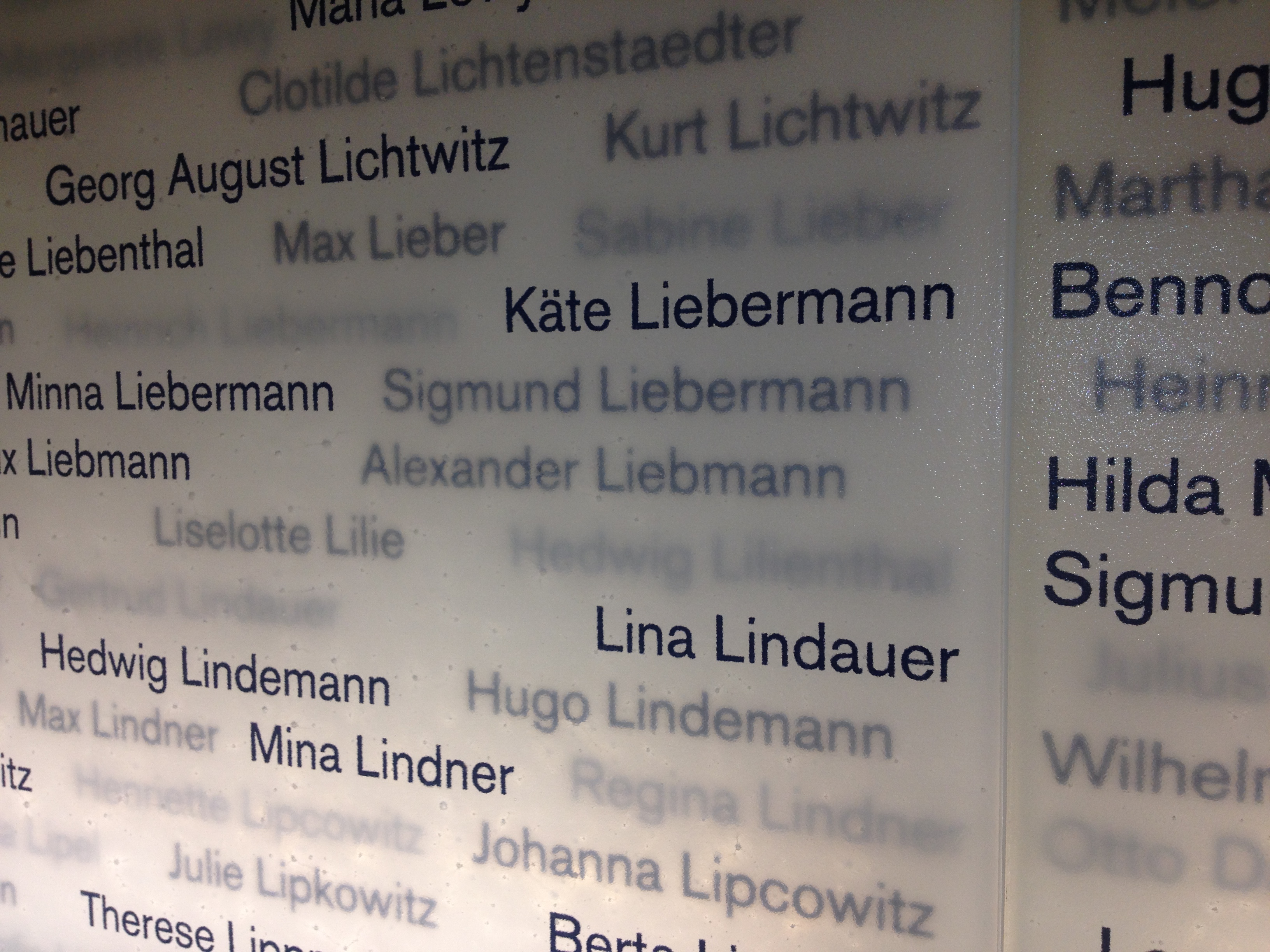
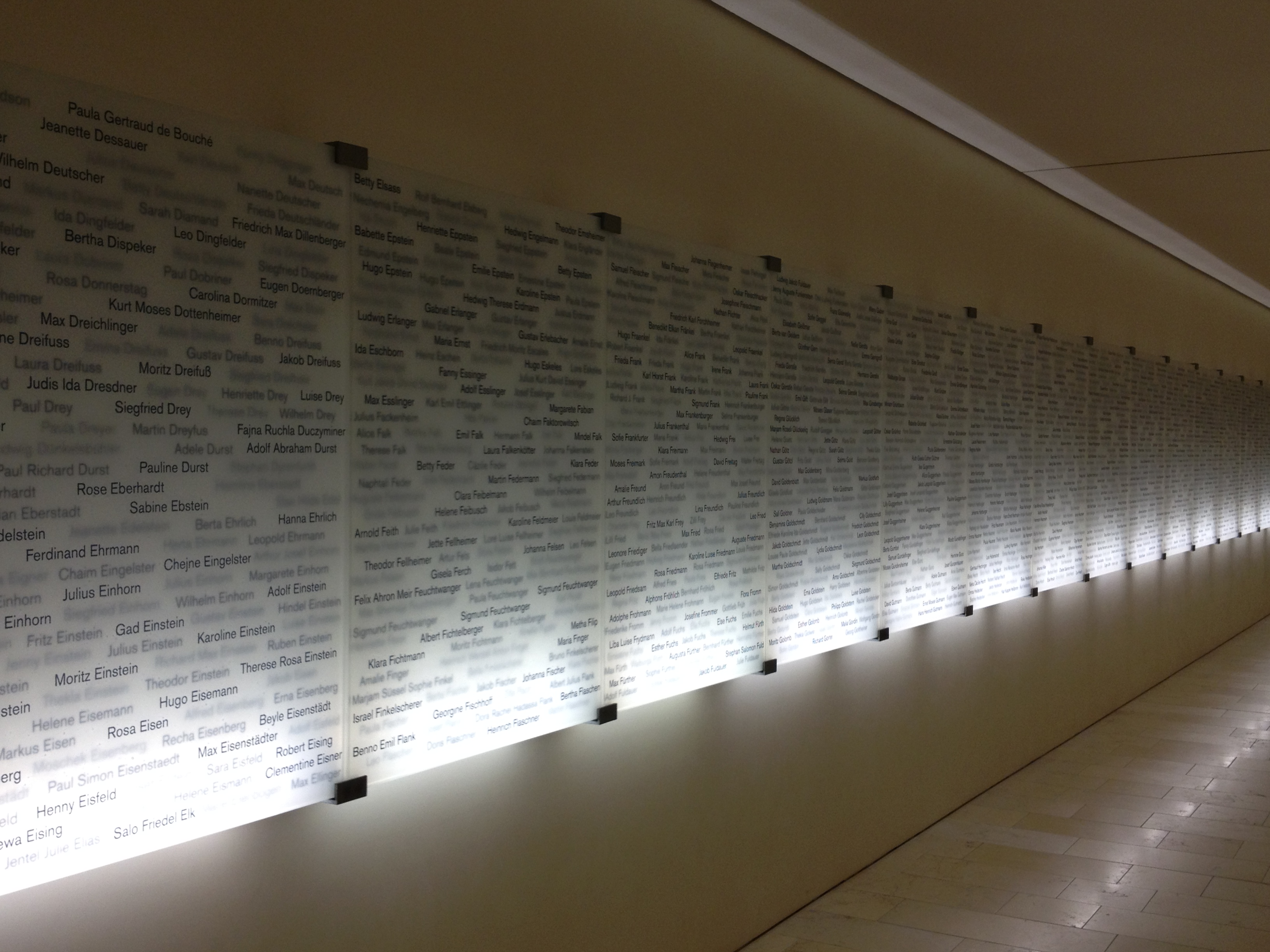
At least to me, it all came to life and (even though you think you know it all, you’ve seen it Picture by Tobias Dennehyall, you’ve read it all) hit me in the epigastrium like the punch of a heavy-weight boxer, bringing tears to my eyes, when she told this one man’s story: Alexander Liebmann. His name is one of the 4.500 names displayed by a very intelligently, very impressively, yet subtly constructed piece of art, the center of the so-called “Gang der Erinnerung” (The Path of Memory) that leads believers and visitors from the community center to the synagogue. A quiet, reflective room, it every meaning of the word. Over a length of 32 meters, 32 glass panels, illuminated indirectly from behind, show the names of every single man, woman or child accounted for as a victim of the Third Reich. In varying boldness and legibility, symbolizing the degree of oblivion that has laid its cloak onto these human’s destinies ever since.

The sheer mass of names alone renders you taciturn, only put into perspective by the figure “6.000.000” engraved into the opposite wall of this Memory Path, above a massive Star of David. Picture by Tobias DennehyAs impressive and shattering as these 4.500 names are, they are abstract, just names. You might walk past, awe-struck, with a bad historical conscience, but you would not be emotionally taken aback. It’s Alexander Liebmann who does exactly that, or better his story that Maike tells while explaining make and meaning of the Memory Path. Like the zoom of a camera onto an individual in the middle of a large crowd:

Liebmann was born on October 31, 1871, in Berlin, where he studied at the Berlin University of the Arts, even travelling to Paris every now and then for research. After working as a teacher, he fought for Germany in the First World War, rPicture by Tobias Dennehyeturning severely wounded and a war hero. His injury made it impossible for him to do most jobs that could have helped him make a living, but he and his wife were gladly employed by a friend as porcelain painters is his ceramic manufacture. When Alexander and Johanna Liebmann received a note on March 27, 1942, to be ready for deportation to a concentration camp on April 3 (simply for being Jews and after receiving the “Eiserne Kreuz 1. Klasse” and the “Hessische Tapferkeitsmedaille” for heroic services in the name of the same country that was now planning to kill them), the couple decided to leave together at least in the manner they decided themselves, if not the when: they committed suicide.

The rest of the tour was still interesting and informative, but it was always Alexander I saw.

As I was standing in front of the only remains of Munich’s former main synagogue which was burnt down by Hitler’s henchmen in June 1938: I saw Alexander there, praying, celebrating the Shabbat.

As I put on the Kippah to respect the house of prayer, I saw Alexander being harassed in his own city for wearing it, for believing.

As I was sitting in the synagogue’s front row, listening to details of the Jewish divine service rituals, looking up to see the last ray’s of today’s sunlight being refracted by Picture by Tobias Dennehythe ingenious metal construction that embraces the massive roof windows and suggests the form of the Star of David over and over: I saw the hope that had left Alexander and Johanna back in Berlin of 1942 – the hope that this place now radiates, for today and tomorrow.

Not only for the Jewish community, but for all of us, especially for our children, who need to remember, always, never forget, understand – and live to see a day when religion is a reason for joy, love and life, not the cause of fear, hate, and death. When the first four words engraved into the wall of the synagogue’s Path of Memory (“remember – mourn – commemorate – admonish”) truly lead to their four counterparts at the end of the tunnel (“learn – reconcile – speak – live”). A day when one of the questions asked after the presentation part of the tour (ironically by a little boy of maybe ten or twelve years of age) whether “Jews and Germans both come here, or only Jews?”, will not need to be asked anymore.

Picture by Tobias Dennehy

Back home, over dinner with the family, we all reported from our day: Chasing our friend’s dog along the banks of the Isar, returning home happy, hungry and tired – on the one hand. Chasing ghosts of the past along the Path of Memory, returning home tired, hungry, and happy to be alive today, to enjoy the fragility of piece with the ones I love. And being willing and able to remember the stories of the past, helping them create a better narrative for our future.

Next time, I think I’ll take my kids along …

Share this:

  • Click to share on X (Opens in new window) X
  • Click to email a link to a friend (Opens in new window) Email
  • Click to share on LinkedIn (Opens in new window) LinkedIn
  • Click to print (Opens in new window) Print
  • Click to share on Telegram (Opens in new window) Telegram
Like Loading...

When is a speech a story? When simply great rhethoric? When just utterly boring?

23 Thursday Jan 2014

Posted by Herr Dennehy in experiences

≈ Leave a comment

Tags

anecdotes, ankur jain, brand storytelling, business storytelling, change, corporate storytelling, digital life design, digital storytelling, DLD14, drama, expectation, hero, Human, HUMIN, jan koum, jay-z, kayne west, Mahbod Moghadam, nancy duarte, rapgenius, social media, steve jobs, Storytelling, surprise, Whatsapp

I had the privilege to be a participating part of the acclaimed DLD (Digital Life Design) Conference in Munich this week. “A global network on innovation, digitization, science and culture which connects business, creative and social leaders, opinion-formers and influencers for crossover conversation and inspiration”, the website says. And that it is.

First time ever for me. Its legendary reputation had traveled eons and light-years to my doorstep as the IT place (as in IT girl, not I-Tee) to be, if you’re even only remotely connected to the Internet and interested in the way digital life continues to change our analogue lifestyles. Worth every minute.

In many ways …

One of these ways I would like to spend a couple of lines on here. Not the networking, not the illustrious guests, the see-and-be-seen aspect or the really inspiring insights I gathered from almost each and every panel or presentation, not even the red-carpet, see-and-be-seen-even-more late-night party, although I quite enjoyed that one, too.

No, it’s the way speeches were held at this conference (as at most I’ve ever been to) and the very rare examples of good storytelling applied in these speeches that I will ponder over a little. I’m not talking about the contents, I’m talking about their structures or non-structures that are mainly based on power point hooks, not narratives. I mean, it’s really amazing: You have so many bright minds, freaks and geeks, young talents and old stagers summoned in one place for three days. They speak about their latest apps, business models, technology, their visions of the future … and all too often you can hardly avoid noticing that most of them do indeed have a story to tell. BUT: They don’t! They don’t apply any storytelling techniques to making their visions, facts and insights less bullet-pointy, less complete, but more compelling, more memorable, more narrative. There was even a panel on “Digital Storytelling”, a very promising title, but in the end merely a discussion over video formats, technologies, platforms and, again, business models. OK, maybe the latter is a very understandable and legitimate topic in a world where traditional businesses are eroding and everyone is desperately looking for straws to clutch at, but it’s not always entertaining for the audience.

So what did many of those speakers do wrong? Easy: They were mainly speaking facts, figures and features. And data and dollars. All in the name of the user’s experience (will always hate that defamation of a word for humans!), but it was mostly the experience of an arbitrary abstract being using technology they were speaking about. Not about concrete human beings, heroes or anti-heroes, their emotions, their dramas that led to the creation of this app or that service (even though maybe the rhetoric of many speeches was dramatic and good and suggested a narrative, where, however, there was none). And I’m not saying that they were not interesting or inspiring regarding facts and ideas transported – after all, you had preachers preaching to Catholics anyway, so ears and brains wide open. I’m just stating the lack of story narrative in the way they were presenting.

Although there were some remarkable exceptions to this rule – or maybe in the land of the blind, the one-eyed man is king?

Mahbod Moghadam, Co-Founder of www.rapgenius.com, a website that only at first sight is something for rap fans, actually unveils the curtain to probably every art’s and even every brand’s future. It allows fans and enthusiasts to make their own annotations to any kind of rap lyric, enriching it with their own stories that connect them personally, to a song and its content. “Annotate My Brand” was the title of the panel Mahbod was on, and he not only used his 45 minutes on stage and his youngster charms well to exchange business cards with Hublot’s Jean-Claude Biver and Missioni’s Angela Missioni. He most of all ignited the audience with his enthusiasm and the great stories he had to tell of the platform’s early days and collaborations with notable rap performance such as Jay-Z or Kayne West. name-dropping was maybe a cheap trick that helped, but his stories stuck. Left me hoping for the extension of his ingenious annotation site to my musical preferences as well as with the notion that: Not only as an artist, you’re work becomes a public good, open to recipients’ annotations; the same holds true for brands. Control is over. Your story isn’t your story anymore, it’s everyone’s. And everyone can and will use this opportunity, and that’s not a threat, it’s a great opportunity to crowd-source your own brand and your company’s reputation. Intriguing thought.

Then there was Ankur Jain, Founder and CEO of HUMIN, “a technology company working to make technology more human”, as his website says. And he started his speech perfectly in this sense: With a human story. With a hero (himself) and a “do you remember when” introduction, pulling the audience (at least those over 25) into their own past, enabling identification with a situation everybody knows: Once upon a time, it took you ages to find out the telephone number of a girl you were interested in, once you had it, you had to take a walk to the nearest telephone box to try to call her with your last coins (as you’re parents were kind of anal on the phone bill issue in the pre-flat-rate era), then dialing the number you had researched, waiting for the ring, hoping her dad wouldn’t pick up the phone, then he did, you hung up, money gone, off back home. Just an anecdote, maybe, but a good, personal intro into explaining what his app was supposed to do: seamlessly connect you with all your contacts on all your various social platforms and address books. Left me entertained and willing to download his app and try it. Which I did.

Or Whatsapp’s Co-Founder and CEO Jan Koum. His visions for his very successful messaging service as well as the sympathy level for him as a person and his work stayed on a low-level for me, even though I love his app, UNTIL: He told the very touching and comprehensible story of this young man emigrating from Ukraine to the USA who missed his parents and family so much, but couldn’t afford regular calls, let alone trips home – so he invented Whatsapp to stay in touch with the people important to his life, instantly, whenever, and economically. I bought into the idea and rationale, and understood even better why I make such frequent use of this little green tile on my iPhone.

What I’m getting at, and what is my personal take-away from three days of insights into digital trends for life and business and business life, is best summed up with one of the many great quotes of one of the great lost storytellers and story-understanders, Steve Jobs: “No matter how good the technology, it will not turn a bad story into a good story.” [http://goo.gl/H1ZCuy] Or a bad speech into a good speech, I might add.

So I’d like to end this stream of thoughts with two videos that are better tutorials for a good speech than anything I could write here:

Steve Jobs’ legendary 2005 Stanford Commencement Address, which is any prime example of perfectly structured story-in-speech, not filmed, not written, but spoken aka told (even if not off by heart, but from the heart). Three little stories turning into one big story at the end, leaving a clear message without needing to name it. Please enjoy this one from beginning to end:


And this more tutorial-like video by Nancy Duarte, an American writer and graphic designer, well-known for her two best-selling books “Resonate: Present Visual Stories that Transform Audiences” and “slide:ology: The Art and Science of Creating Great Presentations”. A very nice summary of how you can mix pure facts with story in a power point, as you mostly need to do in business presentations or speeches, nevertheless not bore to death with report style, but also not get lost in anecdotia or storyland.


So, what do you think? Agree? Disagree? Why?

In any case: I’m happy to see you again soon, here, where the story goes on … soon.

Share this:

  • Click to share on X (Opens in new window) X
  • Click to email a link to a friend (Opens in new window) Email
  • Click to share on LinkedIn (Opens in new window) LinkedIn
  • Click to print (Opens in new window) Print
  • Click to share on Telegram (Opens in new window) Telegram
Like Loading...
Newer posts →

Join 74 other subscribers

Archives

Archives

Follow storycodeX on WordPress.com

Looking for something?

Archives

Website Powered by WordPress.com.

Privacy & Cookies: This site uses cookies. By continuing to use this website, you agree to their use.
To find out more, including how to control cookies, see here: Cookie Policy
  • Subscribe Subscribed
    • storycodeX
    • Join 74 other subscribers
    • Already have a WordPress.com account? Log in now.
    • storycodeX
    • Subscribe Subscribed
    • Sign up
    • Log in
    • Report this content
    • View site in Reader
    • Manage subscriptions
    • Collapse this bar
 

Loading Comments...
 

    %d