
Tags
change, easter, expectation, narration, story, story cubes, Storytelling, surprise
It’s a crux with these holidays: When you think they’re finally over, the next one is just around the bend. Christmas, birthdays, Saint’s Days, … and Easter. Just around the corner, again.
And even though our beloved Easter bunny (apparently) has limited storage capacities (unlike Santa with his big sack), there are somehow always some small oder medium-sized toys (so-called SMT’s) that find their way into the nest where only chocolate rabbits and sweets should be.
But what if good ol’ Bugs accidently brings a duplicate or something unpopular, something endlessly uncool?
No worries, I have a replacement recommendation for you. I mean for Mr. Bunny, of course.
It’s called “Story Cubes”, a simple, entertaining, educating game, and it’s about pure storytelling. The packaging says: “Age 6+”, but it also works with younger children, showing us once again that storytelling is a human gift, engraved into our DNA, a pure form of human communication behaviour for which you need no education, no theory, just infant practice.
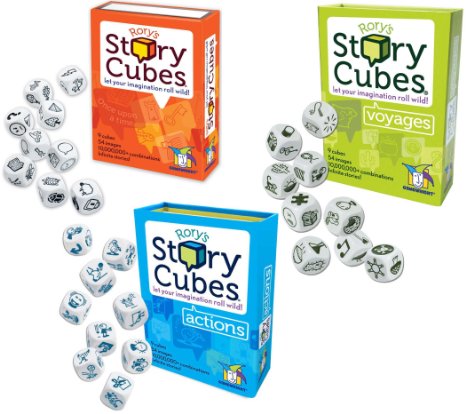
“Story Cubes” currently comes in three variations: the “classic” version, the “actions” version, and the “voyages ” version. You can play any variant on its own or randomly combine them.
It goes like this: There are 9 dices (aka cubes) per story cubes set, and every side of every cube carries a different image, like a monkey, the piece of a puzzle or a camera, for instance. The player whose turn it is throws all nine cubes at once. He then needs to bring the cubes into any given order by chaining one image to the next – like chapters of a story. While doing this, he tells the plot of the story he is just laying out on the table – the drama that turns the images from mere symbols into the different acts of a story. This can be short and sweet, or long and epic, depends on the player’s narrative breath and imagination.
What is interesting: The game has no winner or loser. It’s just about telling good, entertaining, surprising stories. Especially for children, but also for us grown-up’s, there’s a high level of creativity and imagination required, in order to have fun and entertain your fellow players.
Plus: You can’t fool kids like you can fool inapt managers or other advertising- and PR-spoilt business individuals: you can’t put anything over them, can’t simply chain one image or word to another and claim it’s a story, when it’s nothing more than bullet points or corporate messages (to stress the manager metaphor once again). And I made the experience, while playing Story Cubes with my daughters, that the infant, naïve rejection of a boring, plot-free succession of words not only happens when they are forced to listen (aka as audience), but also when they are the storytellers themselves. They actually interrupt themselves with the comment “Can I start again? This story is boring, nothing’s happening!”
That’s how they learn the craft – and intuitively follow the StorycodeX of Expectation, Surprise and Change. A CodeX that also needs another vital ingredient, the Hero or Protagonist who this surprising change is happening to, always an organic, unwitting part of my kids’ Story Cubes stories …
But I’ll write about the Hero Phenomenon in a later post – when I’m back from my Easter Holidays, NOT playing Story Cubes, as the rest of the Mr. Bunny’s presents were indeed a slam-dunk. 🙂
 1. It’s listening time, the age of attention and conversation. So: Listen to your audiences. Find out who they really are. What they really need, what they want. And where and how they want it.
 2. Observe your competition. Don’t be a “Me Two”. Be different. Be authentically you.
 3. You can only be you, if you know who you are. So: Find your big story, your identity, your character, your DNA. Again, this can only be achieved by listening. To yourself, your own organization from top bottom, left to right. To your audiences (or target groups, as you might call them). See where the delta is, where it matches, where it doesn’t. And somewhere amidst that cacophony of data: there’s your big story. Once you find it: stick to it!
 4. Continuously search for all the stories within and without your organization that fill your big story with proof and bring it to life – credibly and authentically, verifiably and true. No matter how small or irrelevant they may seem: They are the only currency you have that differentiates you from your competition. Messages, Brand Ambitions, Visions, and all those bullshit-bingo Whatchmacallits are interchangeable, just hot air, written by expensive agencies to make you feel special. What truly makes you special are your stories, and your people or the people who make up your target audiences, for they are your stories’ heroes. And nobody else!
 5. Become Sinatra, find your way, and then do it your way. If you believe in your idea’s brilliance and capability to tell all your stories great and small, the stories that in the end all make your big story, the accuracy of fit to your character, then go for it! Always follow
 7. Once your pilot’s taken off, make no casualties, no compromises. Be resilient and consequent. The windmills of doubt and Schadenfreude will be blowing into your face from all directions. Don’t let them stop you. And find yourself a trustful companion who will stick by your side, even if one or the other of the journey’s adventures turns out to be a failure or at least different than expected. If this companion is also willing and able to tell your story and stories, a good and true storyteller, who doesn’t necessarily need to be an experts in your field of business, all the better. He (or she) just needs to understand you and be able to translate your management brand identity mission-vision-value-proposition messaging bullshit into stories somebody actually wants to hear.
 8. Even if you’re out (or in) there alone, all by yourself: Be consistent, stick to who you are, what you believe in. Work on your own little moonwalk and surprise audiences and critiques, leave them awestruck.
 9. How do you convince critiques and Benkenträger, prove them wrong? Right: through hard facts and figures they can’t neglect or deny. Seriously, anything procurement sharks, engineers or sales guys trust more than numbers on a paper or screen or power point? So give em what they want: Develop objective KPI’s, measure every customer’s every movement and interaction with your story, present the results in a comprehensible and comprehensive way, and then: Poke your tongue at them, or – if the figures suggest so – have the guts to admit they were right, and it didn’t work.
 10. All along the way, every second of your adventure of finding yourself, understanding your competitors and your audience(s), finding all your stories great and small, finding your formula, pulling it through and sticking to your idea like Jacko to white socks … make sure you do it with someone you trust. Someone on your wavelength, with the same vision, as well as balls and management position to back you up when the FBI is up your fundament to shut your business down.
 11. Last, but oh so very not least: Every truly unique, innovative and successful business story needs … investment. Not only of money, although it needs a lot of that also, make no mistake; investment in the stories themselves, of course, but also for the stories’ marketing, as nobody is really waiting for your corporate story! But you mainly need to invest a looooot of time, and need to give your story project time to grow, like a tree: from seed to graft to full-grown plant. In a nutshell: You need Herzblut: belief, commitment, passion, and stamina.
 storycodeX