• home.
  • blog.
  • storytrain manifesto.
  • stories.
    • songs.
    • poems.
    • /answers.
  • publications.
    • articles & books.
    • videos.
    • interviews & reports.

storycodeX

~ The art of story in life, business and business life.

storycodeX

Category Archives: StorycodeX

“The Deserted Park Bench Jacket”: Perspectives on a story with many plots …

14 Friday Nov 2014

Posted by Herr Dennehy in experiences, StorycodeX, Uncategorized, What is STORY?

≈ Leave a comment

Tags

authentic, Authenticity, drama, every-day stories, expectation, hero, imagination, listening, narration, plot, Storytelling, surprise. suspense, true story, Truth

Stories are everywhere around us. In every part and place of our lives.

Only: we are often much too busy to see them. Too blinkered by life’s challenges, the haste of getting from A to B, the illusion that life is a to-do list, and idleness evil.

Open senses are all it takes to escape this gridlock that makes so many of us unhappy; open eyes open up new perspectives.

Here’s a story (or rather a couple of possible plots) I literally stumbled upon while running in a close-by park – not away from anything, not towards anything, actually in circles, letting my thoughts do the same.

It’s the story of this deserted park bench jacket.

IMG_0263.JPG

*Disclaimer: I didn’t put it there for this post.;)

My circling mind started asking: How did it get there? Where does it comes from? Who and where is the man (was it a man, just because it’s a man’s jacket?) who left it there? And why did he do it?

Plot #1:
The jacket belonged to a homeless man. Lying there, taking a rest from life’s endless atrocities and perpetual failed hopes. Fell asleep in the first rays of warm sunlight surrounded by the colour of hope after yet another night in the rainy cold, looking for shelter, in vain. Hungry, thirsty, desperate, and so terribly tired, tired of life. When, after many hours of peaceful slumber, he was approached by strollers checking on him, he didn’t move. An ambulance was called, but arrived only to find out that the nameless man had passed away, covered by death’s cold hand in the late morning sun. Who was this man? What was his story? Which conflicts and pitfalls in his life brought him to this lonely park bench? And why was the jacket still there?

Plot #2.
The jacket belonged to a man in his mid-forties who had been sitting there, trying to collect his thoughts, agonizing over the best way (if there was one) to avert the imminent drama in his life. The U-turn it was about to take, inflicted only by his own stupidity of cheating on his wife. After all that they had been through, one single moment of vain joy now thwarted it all. Would he ever see her again, his son? After his confession and pleas for forgiveness, honest, but (to her) lame promises, she had thrown him out of their house. Marital silence ever since, he was sleeping at a friend’s place. Suddenly, on his walk through the park, mixing fresh air with chain smoke, his phone rang. It was her. Asking if they could meet. Right away. He jumped up in incredulous joy, already on his way while she was still on the phone, completely forgetting his jacket. A happy ending?

Plot #3:
The jacket belonged to a business man who had messed with the wrong people. Pushing his luck for the deal of his life with different parties, closing the bargain with the one side, pissing off the other, like real. And the other party was not the one to piss off. A thing he didn’t know, but was soon to find out on his daily walk in the park to work. The three thugs came out of nowhere, dashing from a blind spot … and then his world went black. Who was / is this man? Is he still alive? Does he have a family? What was the deal about, and what was really behind this ambush? And why did the jacket stay there while its owner has gone missing ever since?

Sounds like fiction? Sure it does, I just made it up. But .. only maybe. Do we know? Do we know ANYTHING about the world around us, our neighbours, every-day passers-by on our way to work?

Maybe the deserted bench jacket story was much more prosaic than this, maybe someone just accidentally left it there while taking his lunch break in the sunny park, fiddling around with his smart phone, then running off in a hurry to get back to work on time. Maybe just someone who didn’t want this shabby jacket anymore, too lazy to throw it into the used-clothes container?

Maybe, maybe, maybe.

There a story behind everything. And everyone’s story has its intriguing moments, twists and surprises. It’s just a question of taking a closer look, a question of perspective, of attitude.

And there is definitely some story up this jacket’s sleeve, behind its former owner for sure. Oh and: next morning the jacket was gone … Woohaah!

After all: Life is stranger than fiction.
Share this:

  • Share on X (Opens in new window) X
  • Email a link to a friend (Opens in new window) Email
  • Share on LinkedIn (Opens in new window) LinkedIn
  • Print (Opens in new window) Print
  • Share on Telegram (Opens in new window) Telegram
Like Loading...

Will Transmedia eat itself for lunch? Or is it the end of Storytelling as we know it?

08 Friday Aug 2014

Posted by Herr Dennehy in experiences, Ideas, StorycodeX, Storytrain

≈ 3 Comments

Tags

App Film, ARG, authentic, Authenticity, Blair Witch Project, brand journalism, brand storytelling, business storytelling, change, cluetrain manifesto, conversations, corporate storytelling, digital storytelling, Disney, drama, expectation, Human, listening, Marketing and Advertising, narration, Ong's Hat, plot, social media, Storytelling, surprise, Transmedia Storytelling, yalda uhl

S T O R Y T E L L I N G …
probably mankind’s oldest communication megatrend.

T R A N S M E D I A …
probably one of the most used communication megatrend buzzwords in mankind’s recent history.

T R A N S M E D I A  S T O R Y T E L L I N G …
probably the most promising combination of communication megatrends for the future.

Some may ask: “WTF’s that supposed to be again???”

Here’s an attempt from The Source of Internet Wisdom:

“Transmedia storytelling (also known as transmedia narrative or multiplatform storytelling) is the technique of telling a single story or story experience across multiple platforms and formats using current digital technologies.

From a production standpoint, it involves creating content that engages an audience using various techniques to permeate their daily lives. In order to achieve this engagement, a transmedia production will develop stories across multiple forms of media in order to deliver unique pieces of content in each channel. Importantly, these pieces of content are not only linked together (overtly or subtly), but are in narrative synchronization with each other.“


A lot of story stuff involved, so I tend to like it, naturally. But also a lot of (digital) technology, channels, platforms. So, really something new? Or just an evolution version of our oldest megatrend, a Storytelling x.0?

Let’s take a look at where the concept stems from:

Transmedia as an idea of collaborative, multi-platform creation and narration origins in the 70’s and 80’s of the last century, in the area of telematic art, where artists experimented with collaborative narration and defined the idea of transmedia.

It soon moved on to the gaming industry, creating so-called Alternate Reality Games (ARG). These are  games that, based on the Internet as a main hub, use(d) multiple other technological platforms like telephones, email and real offline mail to tell and simultaneously create different parts of the game’s story in those medial habitats relevant to the players. So not just transmedia telling,  but transmedia engagement that requires interaction from every gamer in order to bring the game’s plot to the next level. In other words: “Players interact directly with characters in the game, solve plot-based challenges and puzzles, and collaborate as a community to analyze the story and coordinate real-life and online activities.” (Wikipedia) An early example being Ong’s Hat.

The next transmedia stop was cinema, bringing the whole idea of alternate realities not only to the screen itself (where we had long been used to getting immersed in alternate worlds), but also connecting these to our real, every day lives. The most prominent example certainly being 1999’s “Blair Witch Project”:


This was not only a mocumentary, i.e. a piece of fiction pretending to be documentary, but also accompanied by a variety of additional, supporting pieces of content such as faked diaries, police reports or interviews that in itself engaged the audience in a captivating manner, adding to the cinema story’s apparent verisimilitude.

That was 15 years ago, and just the beginning …

Since a couple of years, also the commercial world of business communications has started to smell the rat? As always, the more consumer-oriented businesses are on the fore-front here with pioneers like Nike or Lego, but it won’t be long before the so-called B2B world will catch up.

So what could all of this mean for business communications and marketing? What can we learn from arts and entertainment?

I recently read this article on transmedialab.org that instinctively made me want to caution a “because we can” attitude that often pairs with technological advancements. The article basically was about the next big thing in cinema and henceforth modern storytelling. Not an R&D future project, but already on the audiences’ threshold.

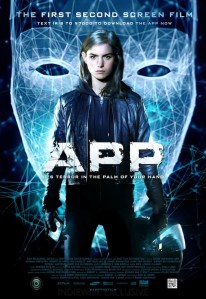
The article begins with a short analysis of the film “APP”. http://www.indiewire.com/article/watch-now-exclusive-trailer-for-app-second-screen-thrillerAPP is the first-ever movie that was written and produced with a 2nd-screen experience in mind, regularly adding content to your phone app while the of the film’s content unfolds on the traditional 1st cinema screen, and thus interrupting the movie’s actual narration.

Hmm, I thought.

Do I like this? Not too sure.

I’ll have to find out…


The article moves on with a glimpse into the labs of Disney’s experiments. These are currently limited to 2nd-screen “content interruptions” to back-catalog films like “The Little Mermaid”, but plans are to integrate the transmedia storytelling idea into the initial screen writing of future film productions.

http://www.transmedialab.org/en/the-blog-en/cinema-and-second-screen-applications-focus-on-the-film-app-and-the-disney-second-screen-experience/

Hmm, I thought, again.

Ambiguity crawling in …

The angel (or is it the devil?) on my shoulder says something like Yalda Uhl who states that “it is very important to engage children in a narration, and that is very difficult to do nowadays with all the distractions and stimulations that surround them. Adding a distraction in cinemas will definitely not help studios to achieve their goal of creating value or attracting an audience that will return to the cinema in the future”. Yes, says the angel (or devil)! REDUCE the distractions! Foster concentration spans! Concentrate on true narration and storytelling to immerse audiences in your story! Don’t just do stuff, because you technically can, audiences will soon get tired and will want to go back to good old traditional storytelling! Transmedia will eat itself for lunch! I knew it!

Then there’s this devil (or angel?) on the other shoulder talking about “story engagement” instead of boring one-way “story telling”. Making it clear to me that the potential of transmedia entertainment and the disruption of handed-down reception models is not only exiting, but in fact the only way to go. For entertainment as much as for business communications, both of them dealing with humans in the end. That today’s young and thus tomorrow’s adult generation will continue to literally gag for regular interruptions in their lives’ routines … and that linear, beginning-to-end storytelling is over, that no one will listen anymore, if there’s not more interactive engagement, audience involvement and multi-channel disruption.

Listening to both of them I begin to see, as with many things, there will be developments that we can’t stop, that will simply happen (because we CAN and because we as humans will simply WANT it), whether I personally like them or not.

Maybe the following

THREE COMMANDMENTS OF TRANSMEDIA STORYTELLING

can help steer technological developments into the right direction:

1. CONCENTRATE ON A GOOD STORY (ALONG THE PATH OF THE STORYCODEX).
Not matter which medium, no matter how many of them; not matter how fragmented and scattered:  A well-told, convincing narration offering a high degree of the “Like Me” effect will always work. It doesn’t have to be chronological, but it needs Expectation, Surprise, Conflict and Change. What will change is the people who will create this expectation, add the surprise and conflict spice, foster the narration’s change – this will not be a classical narrator instance anymore, this will be multiple parties engaging in different parts of a story from different angles and perspectives, in different places. But a story it will still be.

2. DON’T LET TECHNOLOGY LEAD THE WAY OF A STORY.
No matter what technological developments the future holds, no matter what devices will surface: Technology is simply an enabler, an easer, a multiplier, distributer, a vehicle. The true power lies in the human nature of communication, conversation, and storytelling.

3. TURN STORY TELLING INTO STORY ENGAGEMENT.
Do listen to, observe your audiences, and maybe(?) realize: The age of (traditional) story TELLING could be over. Never the age of STORY itself, but maybe tomorrow’s audiences will really want fragmentation, want to be stimulated from multiple sources and in multiple places. Of course, THE CONCEPT OF STORY will and cannot change, it’s genuinely human, but: Maybe the future is indeed more about story ENGAGEMENT, involving audiences actively in plot creation or character development. This would radically influence scripting, e.g. by taking devices and reception environments into consideration when writing a story’s various chapters.

Again, all of this holds true not only in arts and entertainment, but also in business, along the infamous, much recited “customer journey”, a journey that is getting more and more complicated, but – if you listen and truly get involved – ever more rewarding for all story and hence conversation participants.

Devil or Angel. Angel or Devil. Both?

Exciting, to say the least.

Hmm, I say.

Again.

Share this:

  • Share on X (Opens in new window) X
  • Email a link to a friend (Opens in new window) Email
  • Share on LinkedIn (Opens in new window) LinkedIn
  • Print (Opens in new window) Print
  • Share on Telegram (Opens in new window) Telegram
Like Loading...

How Does Story Relate to Business?

22 Tuesday Jul 2014

Posted by Herr Dennehy in Ideas, StorycodeX, Storytrain

≈ 1 Comment

Tags

emotion, leadership through story, negative, positive, Robert McKee

Although I find the following video a little too self-adverstising, and the first 30 seconds are basically a not-to-click teaser, I urge you to go beyond this initial downer.

Because: the essence of Robert McKee’s take on business story quoted here is actually worth inhaling:

  1. Allow the positive AND the negative!

  2. Don’t be afraid of EMOTIONS! All decisions, no matter how rational, cause change. And change causes emotion.

  3. Stories equip us to live. Data and pie charts do NOT!

  4. History’s best (or most influential) leaders (political, business, wherever) have been great storytellers, using stories to lead.

Now that’s definitely a good start to creating more meaningful, more convincing, more persuasive content in business communications.

Give it a try!

Share this:

  • Share on X (Opens in new window) X
  • Email a link to a friend (Opens in new window) Email
  • Share on LinkedIn (Opens in new window) LinkedIn
  • Print (Opens in new window) Print
  • Share on Telegram (Opens in new window) Telegram
Like Loading...

The StorycodeX of Expectation, Surprise and Change; Introducing “Hero 2.0”!!!

11 Wednesday Jun 2014

Posted by Herr Dennehy in Ideas, StorycodeX, Storytrain

≈ 1 Comment

Tags

brand storytelling, business storytelling, change, conflict, corporate storytelling, drama, expectation, hero, hero 1.0, hero 2.0, life, Marketing and Advertising, narration, plot, Robert McKee, story arc, surprise, true story

A couple of months ago, I introduced a schematic, illustrative version of what I believe is the essence of any good, real story: the “StorycodeX”. A very basic how-to and what-to-include. A code with must-have elements, but also a code that allows “X” variations, no one-fits-all execution, but a necessary basis in order to reach your storytelling purpose; be it entertainment, information, infotainment, messaging, catharsis, action, … you name it.

It started off like this, with Story Arc Phase 1:

storycodeX_DHD_1a


Isn’t that course almost every one of today’s so-called corporate or business “stories” is taking? It begins somewhere … and goes nowhere. Nuthin happenin. Boring! Like totally.

Gladly, there is always an end to this misery, but it’s not a story’s end, it’s an mpeg’s end, and sometimes this misery is a loooong torture. Such communication products are indeed a serious hazard to our mental and physical health, no kiddin, head injuries from falling asleep and banging your head on the table being just one of many to caution.

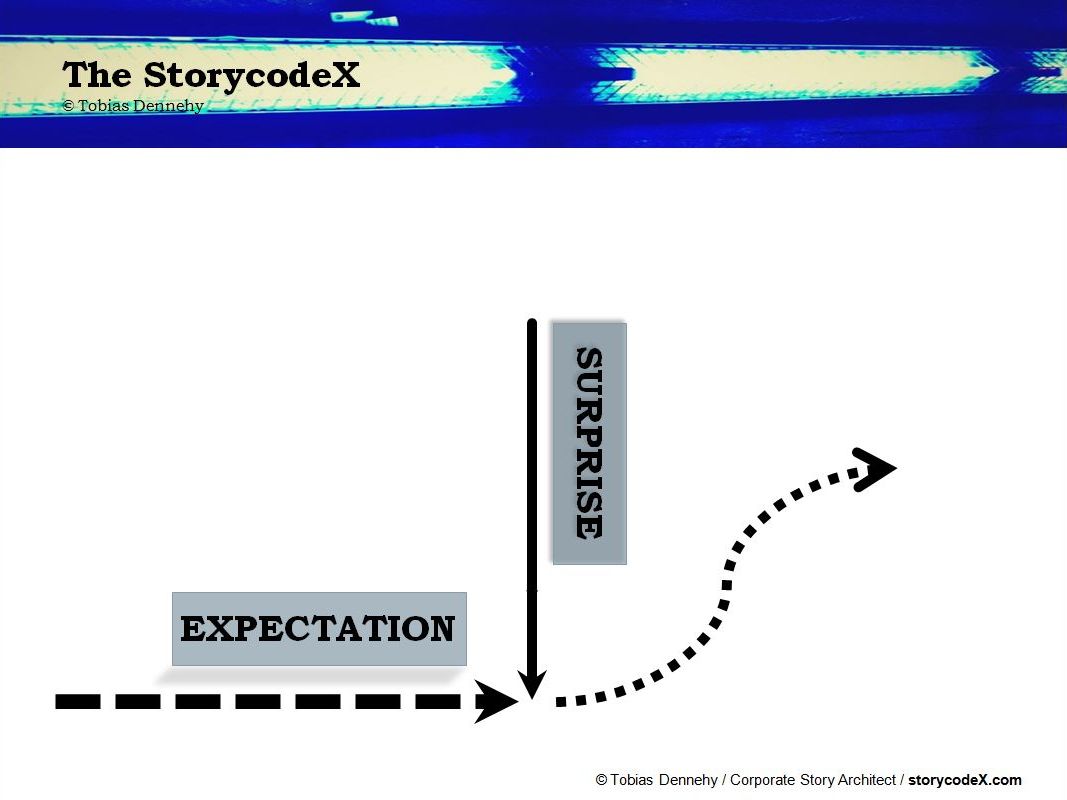
So, what we at least need is to rouse a little bit of EXPECTATION on the audience’s side, EXPECTATION that the above arrow is actually leading somewhere. And this somewhere needs to be a place we actually want to travel to:

storycodeX_DHD_1b


OK, now what happens when you create high EXPECTATIONS? Right: You’re gonna have to deliver. Deliver something interesting to the audience, something you ex- or implicitly promised in the first phase or your story arc. This suggestion can be made by means of story content (meaning the What, action or words) or story making (meaning the How of story creation, music, visuals, etc.). But if you create false hopes with cheesy, cheap special effects or bull-shit-bingo slogans, and then the above arrow goes on in an infinity loop of boredom, and there also goes your audience!

To avoid this mess, Story Arc Phase 2 kicks in:

storycodeX_DHD_2a


Ideally, this something happening is something SURPRISING, but definitely it needs to be something meaningful. Meaningful not for you as producer or maybe even the narrator, if you have one, but meaningful for the immanent story logic and its hero(es):

storycodeX_DHD_2b


Such an incident again needs to ignite a new sense of EXPECTATION, a hope that this SURPRISING development in scene or action will actually lead somewhere, somewhere else, somewhere new, somewhere unexpected. Because: If just anything happens, expected or not, and the dotted arrow of boredom we started off with slithers on as before: There goes your audience, again. But this time it’s not only bored, now it’s also angry! Because you fooled them, lured them it into watching, listening or reading for longer than initially planned. And then (gee, you actually almost had them!): disappointment galore. Thank you for flying with Never Come Back Airlines!

What the audience was hoping, ideally even gagging for was: a turn in the story’s plot, in the hero’s life, leading him (or her, or them) to a different place (literally or psychologically, spiritually) as a consequence of everything that happened before. Hero and audience are confronted with a different world than when the narration commenced, and both need to deal with it:

storycodeX_DHD_3a


This altered direction is indeed a story’s (and in fact life’s) vital ingredient #1, an ingredient every good story ever told has (literally making story a metaphor for life). I’m talking about CHANGE:

storycodeX_DHD_3b


But no CHANGE without life’s vital ingredient #2: CONFLICT. Corporations hate this beast, lock it up in a cage, try to kill it in every part of their shiny, the-world-is-perfect advertising and PR, but the son of a gun somehow always manages to escape!

Life is full of CONFLICT. CONFLICT is life’s spice, the only ingredient that really fosters CHANGE – as in story. So, if life or a story just steadily flows like a calm river without anything happening, without any CONFLICT occurring, the result might be great for meditation, but when it comes to purposeful, infotaining storytelling, what you get is one great big “YAWN”. This CONFLICT need not be explicit or even literally happening: inner conflict or narrations in retrospect are very often even more exiting modes of storytelling than the in-your-face alternative.

So, somewhere above (or below or in the midst of) every plot, every action (f)lies:

storycodeX_DHD_4a


CONFLICT, however, should never be a self-serving element, a shocker, a special effect. It needs to happen to someone, this someone being (oh, quelle surprise!) a human being. Not a product. Not a solution. Not a service. Generally: Not a thing. So if anyone comes around asking you to create a campaign where “the product is the hero”: Fire him! And if you can’t fire him, cause he’s your boss, please argue him out of this idea. “The product is the hero” communication efforts are the most dangerous of all in regards to the afore-mentioned banging-your-head-on-the-table hazard!

Seriously, I know it sounds real wacky and kind of common sense, but decades of engineers and product managers becoming part- or full-time communicators, decades of one-way make-believe and hiding-lies-behind-effects advertising is over. Maybe not completely, yet. Maybe not today, completely. But soon, definitely.

So, to complete the StorycodeX and give the picture both its frame and its core, I proudly present the conversion of HERO 1.0 (the one who started his journey on the left side of boredom arrow, lived through EXPECTATION, SURPRISE and CHANGE in one or numerous iterations, depending on the story’s epicness) into HERO 2.0 (a different version of the same person, altered, in a positive or negative way) through CONFLICT:

storycodeX_DHD_5


CONFLICT and business communications rejecting this phenomenon so fervently, refusing the acknowledgement of the negative is a great topic, definitely worth a blog post here … maybe some other day… 🙂

Share this:

  • Share on X (Opens in new window) X
  • Email a link to a friend (Opens in new window) Email
  • Share on LinkedIn (Opens in new window) LinkedIn
  • Print (Opens in new window) Print
  • Share on Telegram (Opens in new window) Telegram
Like Loading...
Newer posts →

Join 74 other subscribers

Archives

Archives

Follow storycodeX on WordPress.com

Looking for something?

Archives

Website Powered by WordPress.com.

Privacy & Cookies: This site uses cookies. By continuing to use this website, you agree to their use.
To find out more, including how to control cookies, see here: Cookie Policy
  • Subscribe Subscribed
    • storycodeX
    • Join 74 other subscribers
    • Already have a WordPress.com account? Log in now.
    • storycodeX
    • Subscribe Subscribed
    • Sign up
    • Log in
    • Report this content
    • View site in Reader
    • Manage subscriptions
    • Collapse this bar
 

Loading Comments...
 

    %d